Star Wars: Episode II – Attack of the Clones Review

Theatrical release poster of Star Wars Episode II: Attack of the Clones by Drew Struzan.

A long time ago in a galaxy far, far away.… there was Star Wars! I will continue my Star Wars series reviews with the second prequel, Star Wars: Episode II – Attack of the Clones! For background knowledge, Star Wars is a film saga of family/sci-fi movies created by the renowned George Lucas. I will be exploring the different aspects of Episode II below.

Plot & Story:

Unrest! Ten years after the Invasion of Naboo, the Galactic Republic is in turmoil. The Separatist Crisis has begun and thousands of star systems have declared their intentions to leave the Republic. At the root of the movement lies former Jedi Knight Count Dooku, planning on overthrowing the Republic.

Politics isn’t the only conflict in the galaxy. Padmé Amidala, the new Senator from Naboo, arrives on Coruscant to vote on the creation of a Grand Army of the Republic. Her starship is attacked and her decoy is killed, escaping with her life. Amidala informs the Jedi that she believes Count Dooku is behind the attack due to her strong stance against the separatists. Jedi Mace Windu and Ki-Adi-Mundi insist that no Jedi, current or former, could take an innocent life, adding he’s a “political idealist, not a murderer.”

We also get to see Anakin Skywalker, grown up, dealing with inner conflict and a tense relationship with his paternalistic master, Obi-Wan Kenobi. They both reunite with Padmé in her penthouse, assigned to guard her from a potential new assassination attempt. The mood is tense as Anakin flirts with Padmé and defies the Jedi Code in front of Obi-Wan.

The second assassination attempt fails and Obi-Wan and Anakin chase the assailant, but before they can get the name of her employer, a bounty hunter with a jetpack kills her with a poison dart. The chase scene here is truly entertaining. The Jedi Council hatches a plan to protect Padmé and to uncover her assailant. Anakin will covertly travel with Padmé to Naboo and defend her there. Obi-Wan will investigate the bounty hunter who hired the assassin.

On Naboo, Anakin and Padmé bond, but it is in vain. Padmé emphasizes that they cannot have a relationship as it is forbidden under the Jedi Code. These scenes definitely suffer from some cheesy dialogue, but ultimately they are enjoyable if you can focus on the story first.

Obi-Wan’s story is even more interesting. He takes the role of a neo-Noir style detective, finding a hidden planet named Kamino where the poison dart was produced. The planet is home to the Kaminoans, a species of cloners who are friendly if you have deep pockets. He discovers that an army has been created at the request of a dead Jedi master at the same time the Republic is in dire need of one. This is highly suspicious. He reports this to the Jedi Council. He speaks to Jango Fett, the bounty hunter, fights with him, and chases him to the planet Geonosis.

On Naboo, Anakin is plagued by dreams of his mother’s death. He informs Padmé he must go save her, despite his duty to protect her. Padmé seems to admire this and consents to go with him to Tatooine, on a mission to save Shmi Skywalker. Anakin tracks her down to a camp of Tusken Raiders who are holding her hostage. His mother dies in his arms, sending him into a fit of rage as he slaughters all the men, women, and children of the camp. Anakin brings his mother back to be buried, breaking down in tears to Padmé, confessing that he’s losing control and he’s not the Jedi he’s meant to be. Padmé feels pity for him and comforts him.

Back on Geonosis, Obi-Wan tracks and spies Count Dooku, Jango Fett, Nute Gunray, and other separatist leaders. He overhears a meeting where they plot to launch a surprise attack on the Republic with newly built battle droids. Their goal is to overwhelm the Jedi and quickly force a surrender.

Obi-Wan returns to his Jedi starfighter, informing the Jedi Council and the Supreme Chancellor of a massive army being built to invade the Republic. The broadcast is interrupted as Obi-Wan is captured by separatist battle droids. The Supreme Chancellor, the Senate, and the Jedi resolve to grant the Chancellor emergency powers, creating a Grand Army of the Republic, led by the Jedi that will invade Geonosis and free Obi-Wan and destroy the droid factory.

Hostage, Obi-Wan is approached by Count Dooku who claims the Republic is controlled by the Sith and that together they can root out this menace. While partially true, this is deception as Dooku is a Sith himself and only desires to turn Obi-Wan to his side. Anakin and Padmé are captured trying to rescue Obi-Wan, but Republic forces touch down and free them. An air, land, and space campaign ensues to defeat the separatists. However, Anakin loses an arm and Count Dooku escapes along with the rest of the separatist leadership. The battle can be considered a tactical victory, but a strategic failure for the Galactic Republic.

The film ends with the reveal that Count Dooku and Sidious (Palpatine) have conspired to create the Clone Army and the war. Dooku even operated under the pseudonym “Tyrannus” when dealing with the Kaminoans. The final shots of the film are a triumphant Palpatine standing over the Clone Army deploying across the stars and Padmé marrying Anakin.

With the Clone Wars already begun, the galaxy is forever transformed.

Music Score:

The music in Episode II was written by the iconic composer John Williams, famously known for creating iconic orchestral scores for classics like Star Wars, Jaws, Indiana Jones, E.T., and Harry Potter. If music could be gold, then John Williams has the Midas touch. My favorite piece from Star Wars: Episode II – Attack of the Clones is “Across the Stars.” It plays during key romantic moments between Anakin Skywalker and Padmé Amidala, like when they share their first kiss and when she admits her love for Anakin. The song starts off like a warm hum with an oboe solo, followed by accompanied wind instruments and a harp. It is real. It is emotional. It is beautiful. The most special part of the song in my opinion is when the string orchestra joins in.

Just like Anakin and Padmé’s forbidden love, this song is passionate, strong, and tragic. Playing during pivotal moments and the climax, this love story is perfectly portrayed by “Across the Stars.” Every time I listen to it, I am just taken away by its enchanting quality. The song is truly a work of art.

Overall, I thoroughly enjoyed watching Star Wars: Episode II – Attack of the Clones. Between Star Wars: Episode I – The Phantom Menace and Attack of the Clones, I would say I am more fond of the latter. The overwhelming themes of romance and forbidden love are more alluring in my opinion, but either way both are amazing films. There is more to come, as I’ll be reviewing the other Star Wars episodes every month, so stay posted! I hope you enjoyed this blog and watch the movie if you haven’t before!

– Sophia B.
Star Wars: Episode I – The Phantom Menace Review

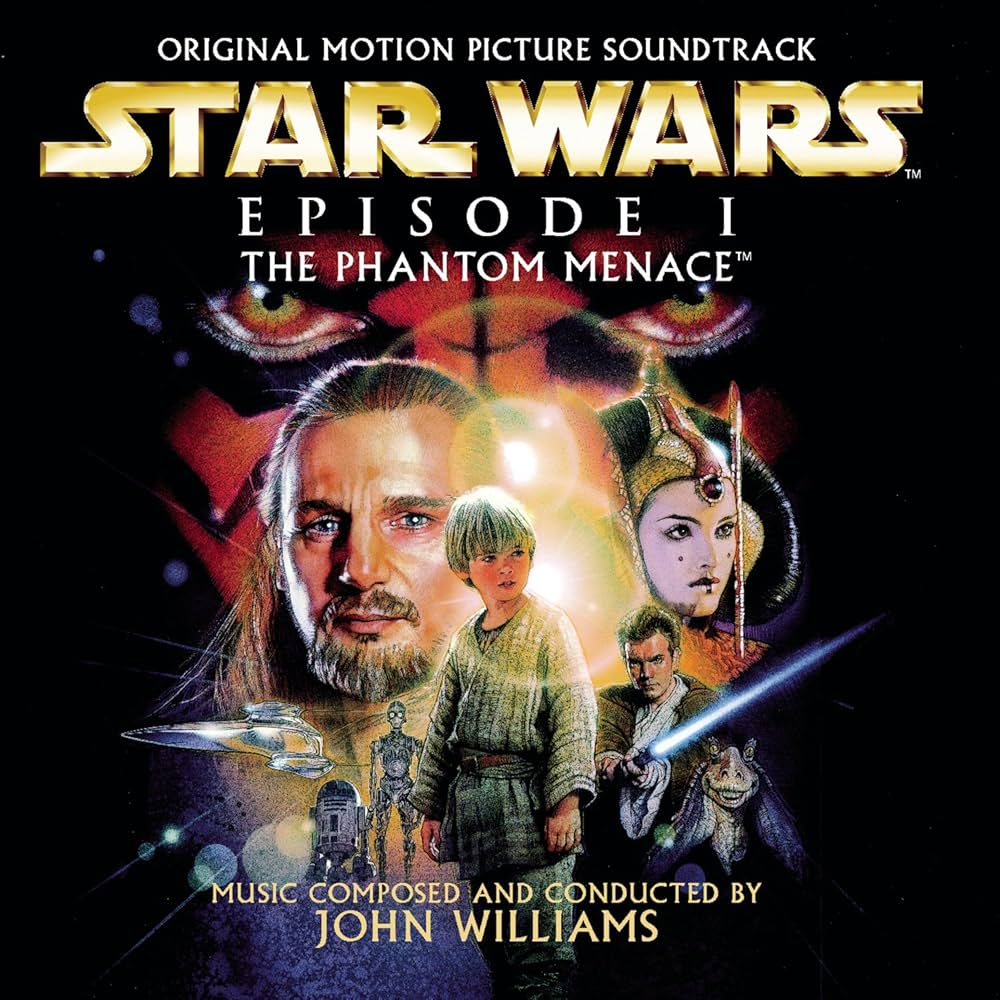
As an avid movie enthusiast and Star Wars lover, I thought it was best to review the beloved series, starting off with the first prequel, Star Wars: Episode I – The Phantom Menace! For background knowledge, Star Wars is a film saga of family/sci-fi movies created and directed by the renowned George Lucas. I will be exploring the different aspects of Episode I below.

Plot & Story:

Crisis! The Trade Federation, a powerful economic organization, has blockaded the peaceful planet of Naboo to take control. Qui-Gon Jinn and Obi-Wan Kenobi, two space warriors known as Jedi, go to Naboo with the goal of negotiating the end of the blockade and protecting Padmé Amidala, the planet’s queen. Once they get the queen to safety and escape, they find a young enslaved boy named Anakin Skywalker who shows potential as a Jedi. Once they leave the planet, Qui-Gon brings Anakin along for Jedi training because he thinks he is meant to restore balance to the Force. The Force is a supernatural ability that allows users to have powers of telekinesis (the ability to move objects with your mind), sense the future and feelings among other abilities. As the battle against the Trade Federation escalates, the Jedi fight against an enemy warrior named Darth Maul. Subsequently, they arrive on Coruscant, the capital of the Galactic Republic. Queen Amidala appeals to the Senate to end the invasion of her planet, but Senator Palpatine informs her that it is unlikely the Senate will act and the Chancellor is powerless to help. Senator Palpatine advises her to push for a vote of no confidence in the Chancellor, meaning the legislative branch votes to remove and replace the executive. Ultimately, by the end of the film, this leads to the election of Chancellor Palpatine, due to a strong pity vote generated by the invasion of his planet. Next, the queen returns to Naboo to fight back with additional reinforcements. The movie ends with Darth Maul killing Qui-Gon in lightsaber combat, Obi-Wan Kenobi defeating Darth Maul, and Anakin starting his path to become a Jedi.

Music Score:

The music in Episode I was written by the iconic composer John Williams, the man responsible for the legendary Star Wars music in the original three movies. Taking inspiration from the orchestral suite The Planets by Gustav Holst, specifically “Mars, the Bringer of War”, Williams crafted an unforgettable soundtrack. My favorite piece from Star Wars Episode I: The Phantom Menace is “Duel of the Fates.” It plays during the battle between Qui-Gon Jinn, Obi-Wan Kenobi, and Darth Maul. The song starts quietly and has the effect of making one’s heart race due to its fast-paced nature and dramatic chanting from the choir. The rhythm makes the battle feel emotional and dangerous, marking the turning point in the movie, as it determines whether the two Jedi will defeat Darth Maul. I also have a personal connection to the song because my older brother performed “Duel of the Fates” at Segerstrom Center for the Arts with his district’s honor orchestra in the front row, which explains even more my deep love for this work of art.

Ultimately, I enjoyed watching Star Wars: Episode I – The Phantom Menace and highly recommend watching the trilogy in the order of episodes I-VI. There is more to come, as I’ll be reviewing the other Star Wars episodes every month, so stay posted! I hope you enjoyed this blog and watch the movie if you haven’t before!

– Sophia B.
Star Wars Galaxy’s Edge: A Crash of Fate by Zoraida Cordova

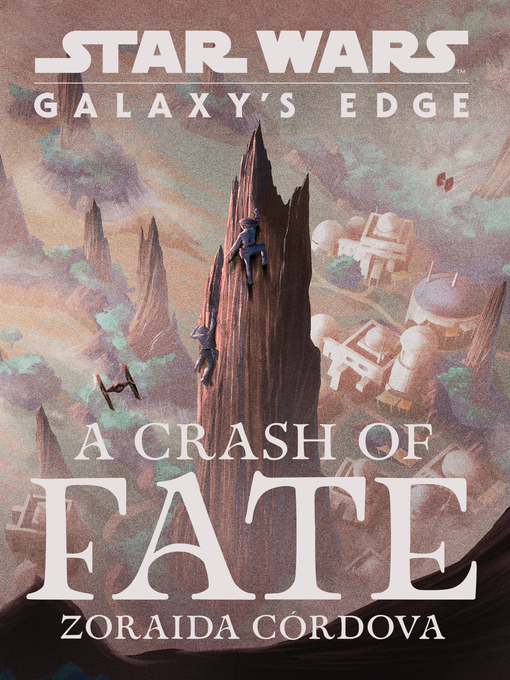
Star Wars: Galaxy’s Edge: A Crash of Fate, written by Zoraida Cordova, is a riveting romance that takes place in the First Order era in the adventurous Star Wars galaxy far, far away.  I picked this book up at Barnes and Noble one day and could not put it down for the next few days!  

Whether or not you have visited Galaxy’s Edge at Disneyland, you will most likely enjoy stepping into the world of this Star Wars planet and following the smuggler Izzy Garsea as she seeks to find her place in the universe.  Along the way, she reunites with her childhood best friend Jules, who remained as a farmer on their home planet Batuu after she left as a child.  Their mutual feelings are rekindled as they come into conflict with the First Order, reminisce about the past, and wonder about a potential future together.  

If you’re not a Star Wars fan, you might find some details confusing, but if you’re a particular Star Wars enthusiast, you will notice all the tiny details that help immerse you in this alternate world.  So if you enjoy a well-written blend of romance and adventure set in the Star Wars universe, then A Crash of Fate is for you!

-Lauren D.

Star Wars Galaxy’s Edge: A Crash of Fate by Zoraida Cordova is available for checkout from the Mission Viejo Library.

Star Wars: The Mandalorian

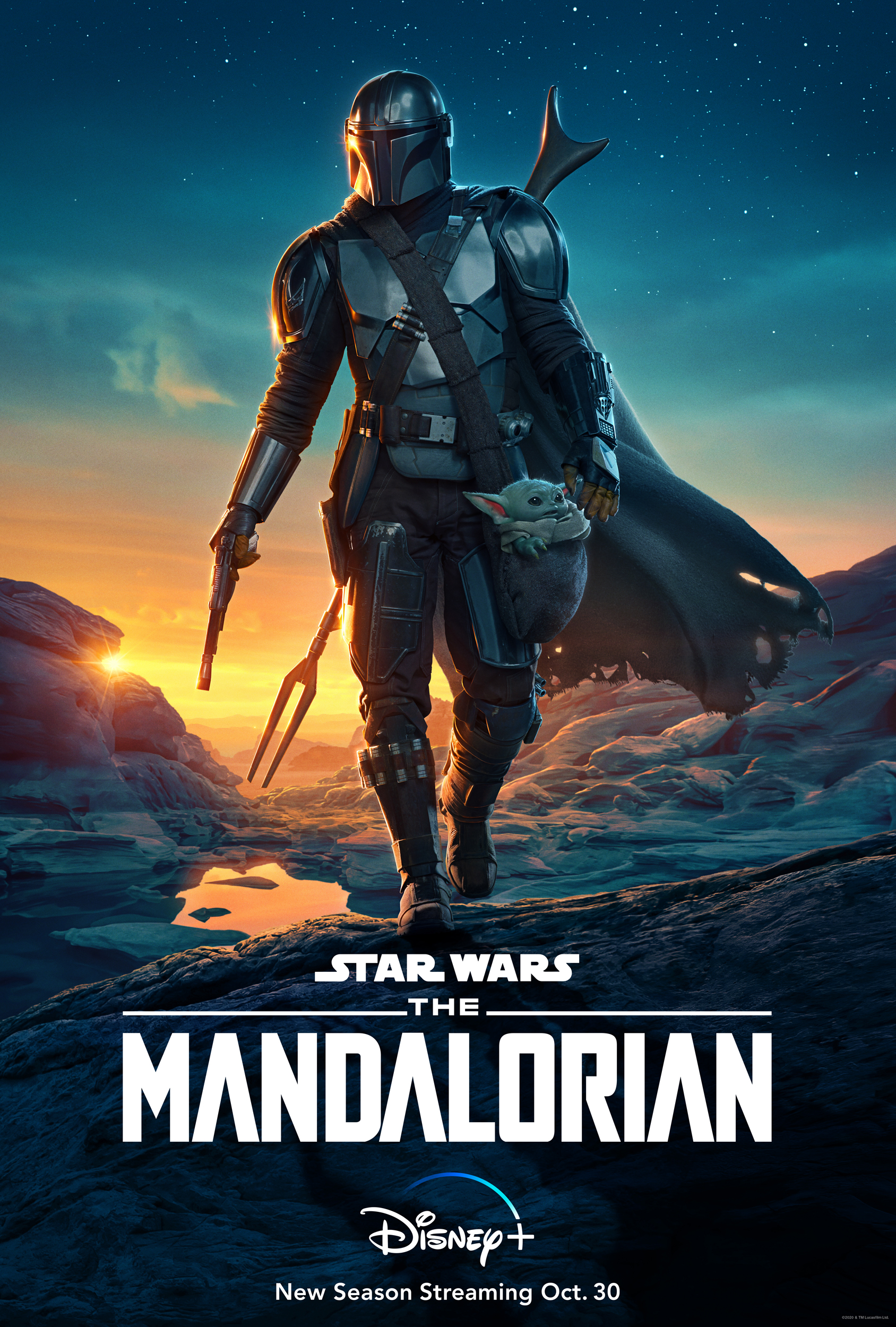
Whether you are casually entertained by the Star Wars franchise or a rabid fan, Disney Plus’ The Mandalorian is a truly fun escape from the humdrum of life since Covid 19.    This Disney Plus series, which now has completed two seasons, takes place after Return of the Jedi and before The Force Awakens in the Star Wars universe.  For those, like me, who thrives on Star Wars lore, the exact year is 9 ABY (After the Battle of Yavin).  During this time the empire has been mostly destroyed and the New Republic has taken over the galaxy and is attempting to bring stability and peace, though corruption lurks behind every turn.  The series follows a bounty hunter who seems to have no affiliation with either the Empire or The Republic.  His aim is to make money for his clan who live in the shadows to avoid conflict with the outside world.  As season one unfolds, a disturbing and sinister connection between the Mandalorian race and the Jedi is revealed that intertwines and blurs the lines of good versus evil.  This blurring of lines persists through both seasons and is inherent to the exciting plot twists within each episode and at the conclusion of each season.  The central story is based around the bounty hunter who sacrifices his position as a bounty hunter to save a child he was meant to deliver to the hands of the Empire.  Instead, he listens to his inner voice and makes it his mission to protect and return “the child” to his people.  This proves a dangerous and challenging odyssey that carries the pair across the Star Wars Universe.  They face sinister and sometimes familiar characters along the way and are often forced to fight their way out of what seems like near-impossible situations.  Along the way, more and more is revealed about “the child” and the unexpected and surprising man who is called Mandalorian.

The Mandalorian (TV Series 2019– ) - IMDb

The mastermind behind The Mandalorian is none other than, Jon Favreau.  Favreau is a director, actor, producer, and screenwriter.  He directed the wildly popular Christmas comedy, Elf.  Additionally, he is the creative genius behind the Iron Man franchise among many other popular films.  Favreau has been quoted as saying that The Mandalorian is meant to “hearkened back to the Westerns and samurai films that had originally influenced Lucas.”  Favreau is referencing George Lucas the original creator of Star Wars. The world Lucas imagined in the original Star Wars movie has been capturing the imagination of audiences since its release in 1977.  Jon Favreau includes himself as one who was fascinated by Star Wars lore and he has built on that in The Mandalorian, staying true to Star Wars roots but adding his own take.  With the expanded format of a TV show,  Favreau has been able to take a deep dive into the Star Wars expanded universe and draw from Star Wars spin-offs including The Clone Wars and the video game, Star Wars Battlefront.  However, there is enough character development, revelations, cliff-hanger, and adventure that even audience members new to Star Wars can enjoy the fun.  Favreau has said that, with this show, he wanted to create a “good party” for the Star Wars audience.  He has done just that.  Grab your family, your best friend, and your lightsaber and join in.  “This is the way.”

-Johnson D.

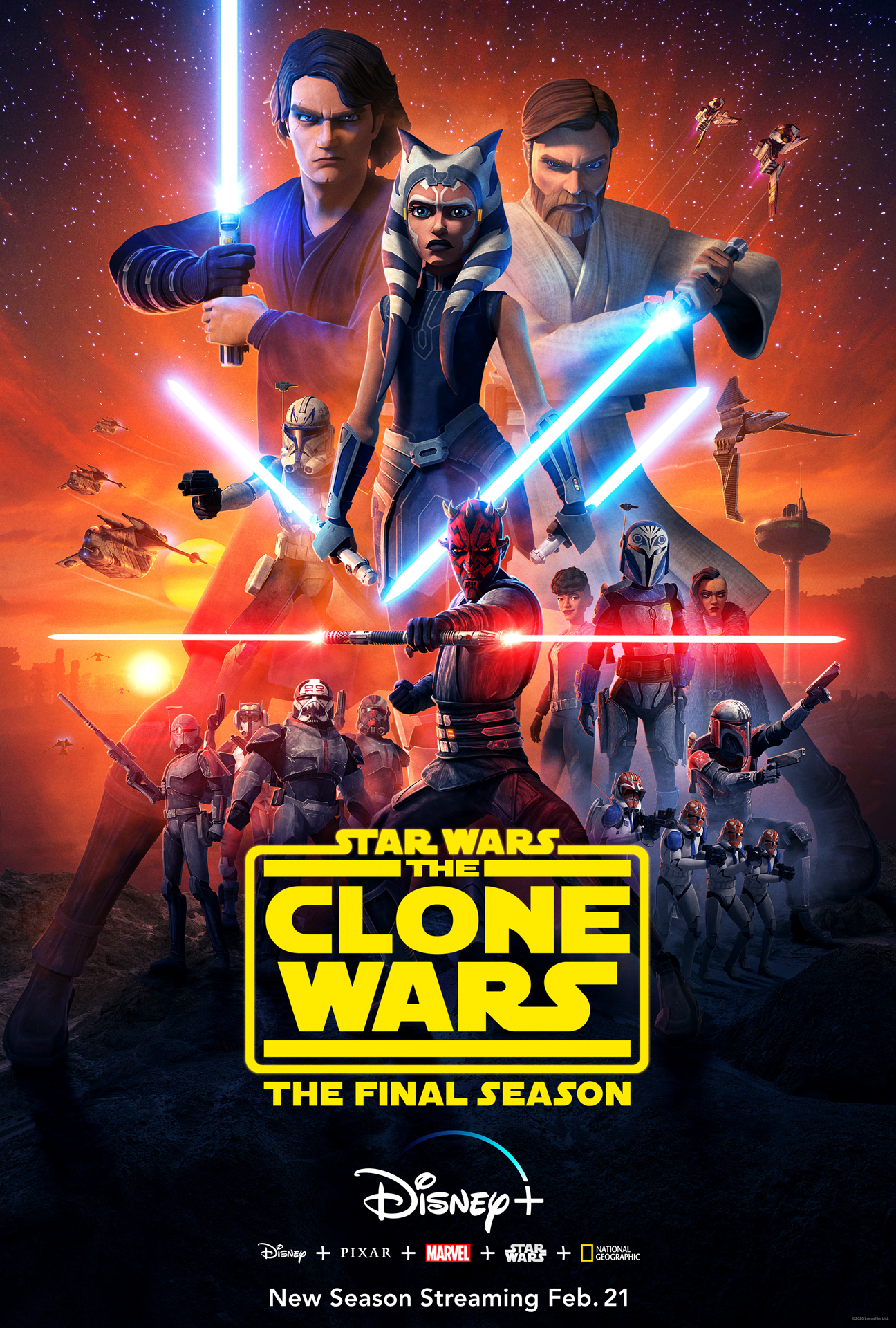
Adding More Scientific Realism to Sci-Fi in Space: Star Wars The Clone Wars

How Just a Bit of Realism In Your Story can Deepen Your World and Enthrall Your Reader

Star Wars: The Clone Wars (TV Series 2008–2020) - IMDb

Last summer, I spent many late nights toying with the idea of a space novel. There were so many questions I had, so many things I wanted to know about the world I was attempting to create, and at times I had no idea where to begin.

As school began and I got busy, my space novel project got worked on less, but I kept world-building in small ways when inspiration came.

Now, on this extended break from school, I have had much more time freed up. One of the things I have done with that time is watch Star Wars The Clone Wars, which is, in my opinion, an incredible expansion to the Star Wars universe.

Star Wars The Clone Wars TV show was one of the many space-fiction stories that inspired my story. Star Wars is something almost everyone, even someone who isn’t a fan, will recognize as trendsetting space fiction. It was a pop culture phenomenon at its birth and continues to be today. I have always loved the light-saber as a weapon, the many well developed characters, and the expansive galaxy enriched by each new location we visit in the franchise.

Through my writer’s eye, I saw the show in a whole new light. With many different military groups, independent systems, the Republic and the Separatists, the Trade Federation and each different type of planetary government, it is an incredible example of how intergalactic politics might work!

While the plot, characters, and lore remain interesting, and model-worthy as well, I did notice a pattern of something missing. Let’s face it, if there is anything this show lacks, it is the realistic elements of science that pull the reader, or watcher, deeper into a new and different world.

Science fiction doesn’t necessarily have to be very realistic, but some great science fiction (Adrift by Rob Boffard and The Martian for example) have used more realistic depictions of other worlds and future technology to make us believe we are reading something that could truly happen in the future, or is happening in a faraway galaxy.

The Clone Wars, for me, raised many questions about some scientific things not fully explained, or certain elements of the “realism” in the story that if tweaked or expanded upon, might make your story much more realistic and appealing. So without further ado, here’s my writing tips takeaway!

Firstly, how do species on different planets evolve, it seems very unlikely they could all be humanoid, get creative! More creatures like Jabba the Hut! This also rings true for making planets at different stages of carrying life, maybe not all planets your character visits have sentient life forms yet. Keeping with life forms, many planets in this show seem to have only one environment. While that can be cool, remember how diverse Earth is! Depending on how you write your story, a planet with multiple environments and lots of different flora and fauna will certainly enrich the story.

Speaking of planets, perhaps the biggest thing that takes me out of the story in this show is the fact that every planet our Jedi heroes visit appears to have the same atmosphere composition, gravity, and relative temperature. Not even two planets in our solar system have the same gravity or atmosphere.

Instead of ignoring these scientific elements, use them! Create a challenge for your characters and interesting worlds with limited gravity that causes cities to be tethered to the planet! Create technology that filters nitrogen or sulfur-rich air so it is breathable. Have suits that need to be worn by your characters in certain acidic or too hot/cold planets for survival. Play around with the environment, and show how your characters would adapt!

Some more questions to ask; How do the conditions of a certain planet affect how life there has developed if there is life? What would an organism from that planet need to survive if it left? How would a sentient being from a specific planet talk, based on air composition (guttural, high pitched, etc.)? Are there different languages, different races, and cultures on each planet? The more diverse a planet, the more real I find it becomes to the reader/watcher.

These are many of the major questions Star Wars The Clone Wars made me ask about my own book, and they inspire a lot of creative thinking for world-building. For my fellow aspiring writers, perhaps the best piece of advice I can offer is to constantly ask questions about the things you write about, challenge the way you think about things to broaden your creativity, and don’t hesitate to add flair and detail to the world you are creating.

-Sebastian E.

Star Wars books, films, and television shows are available for checkout from the Mission Viejo Library. Additional material can be found online for free through Overdrive

The Strange Case of Origami Yoda by Tom Angleberger

The Strange Case of Origami Yoda is a very great first book to a very interesting book series. The Strange Case of Origami Yoda is about a bunch of 6th grade middle school kids who make case file trying to decode the mysterious origami Yoda and the kids who makes Yoda, Dwight. Tom Angleberger’s book is a masterpiece of humor, storytelling, and funny drawings. The book even contains a little middle school romance.

Two things that make this book unique is the way it tells the story and drawings. The way this book story is told is through many different peoples perspective. This book is case file, so a lot of different people tell different funny stories in the book. The drawings all over the book really makes the book stand out. You got give Tom Angleberger and Jason Rosenstock, the two people who drew all over the books. The drawings inside the book make the book more teen-friendly. And, an added bonus to this epic case file, there are instructions on the last page on how to fold a legit origami Yoda! This book is a book I would recommend to all ages. Make sure to get it!

-Brandon D.

The Strange Case of Origami Yoda by Tom Angleberger is available for checkout from the Mission Viejo Library

CT-7567

This is the story of CT-7567, also known as Captain Rex who was introduced to the Star Wars universe in the animated series, The Clone Wars. Monthly installments will be released. Hope you enjoy.                                                                                                   _____________________________________________________________________

CT-7567 was having a great dream before the datapad next to his bed woke him up. It flashed red and blared,

“CT-7567, prepare yourself for morning Physical Training.”

The young cadet rubbed his eyes, jumped out of bed, and shook his bunkmate awake.

“Come on, 2224! We’ve gotta go!”

CT-2224 slowly and methodically rolled off his bunk and dressed himself. Once 2224 was ready, the two clone youths jogged over to the training area. Their instructor, Bani, waited for them. The Duros was irritated.

“You’re late again! How many times do I have to tell you?”

He made the two clones run laps until they were sweaty and miserable. Cody, or CT-2224, grumbled under his breath as they stepped into the sonic refreshers. Rex, who was designated CT-7567, was equally displeased. He knew they had gotten there on time. The eternally irate Duros always found something wrong.

Their next assignment was their favorite: Battle training! As they hefted their mock blasters and blew holographic droids into oblivion, they joked and laughed. Battle training never failed to cheer them up. Rex especially loved using special tactics to destroy the fake droids, who always used the exact same formation and strategy. He had just attacked a huge wave when something hit him in the shoulder. He stumbled forward and whipped around. It was CT-6453. What a jerk. Rex always saw him around, bullying cadets and bothering teachers.

“Eat bantha dung, 43.”

Rex waved him off. Little did he know how important 6453 would turn out to be.

The last assignment of the day was worse than PT: Galactic history. Their teacher was a hardworking taskmaster. The Kaminoan, Lima Bri, gave them tons of work and papers, and she never graded easily. Rex was feeling good about a report he had written about the moons of Io, but when he got it back Bri had given him only 75%. Cody was disappointed as well. His paper had received a 73%. They left class and headed back to the barracks to grab some sleep.

-Joshua M.

Film Review: Solo: A Star Wars Story

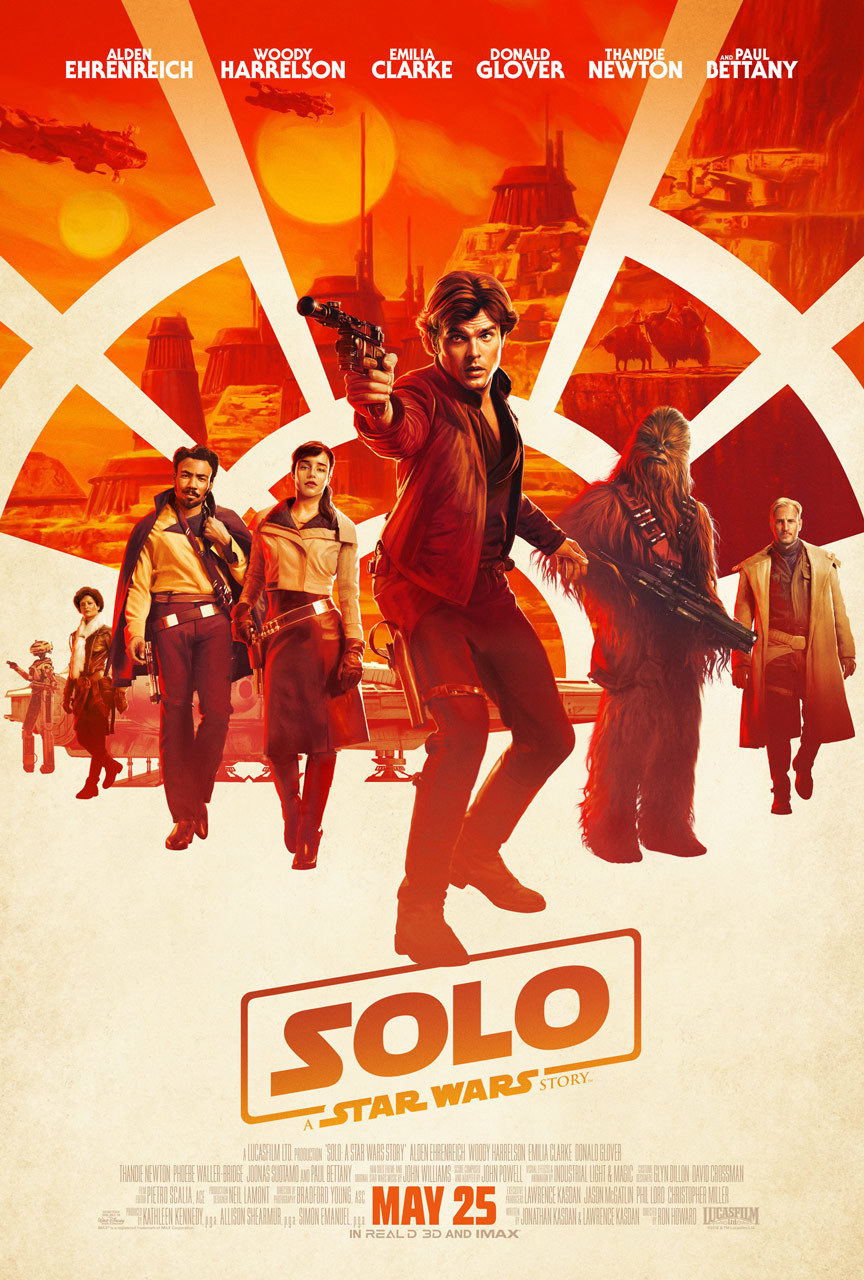
I have been a fan of  Star Wars ever since I was little and was super excited when Disney picked up Star Wars and started making more movies. But, I was just disappointed in them and I was hoping this movie would be better. It was. It wasn’t great and I’m sure I didn’t completely dislike because it was Disney.

It was really interesting getting to learn Han Solo’s backstory. But there was so much more room for a more creative story. It in some ways filled in the gaps of who Han Solo is in ways that I didn’t really like. I didn’t really like the way they portrayed all the characters it made some of them seem different than who they were in the original movies. Some of Han’s backstory did also seem like it was a bit similar to Darth Vaders because Disney characterized them in similar ways .

Also, even though it is Han Solo, it bugged me that Disney had to put in yet another one of their cliche love stories into the movie. It in a way it reminded me of the Padme and Anakin relationship.

I did like the fighting scenes though. There was some classic Star Wars style fighting scenes and special effects that I really enjoyed watching. It helped the movie seem like a Star Wars movie.

I still enjoyed watching the movie and would totally recommend any Star Wars fan to watch it. But it isn’t really about the storyline, it’s more about the special effects and fighting.

-Ava G.

Ultrasabers: Prophecy v3

Are you a Star Wars fan? Well, if you don’t have one of these, you aren’t. Introducing Ultrasabers, the finest custom lightsaber company out there. With these sabers, you can duel to whatever intensity your heart desires. The site has everything, from double-bladed sabers, to crackling crossguards. While the price may seem a little much, you’ll be absolutely amazed by what you receive.

For my first saber, I chose the Prophecy v3, which is based on the hilt that Anakin Skywalker used in Episode II: Attack of the Clones. This saber was eventually lost during the Battle of Geonosis. I ordered it with Obsidian LITE soundboard, an Ultraedge Heavy Grade blade, and, for the color, Guardian Blue. When I first got it, some factors that surprised me were its weight, color, and volume.

Let me tell you right now, if you think holding a fishing rod one-handed is too heavy, you’ll have one heck of a struggle keeping these sabers suspended in your hand. When I first picked it up, I had to use two hands, but as I practiced with it, it got lighter and lighter. Another thing was the color. On camera, the blade appears white with a blue hue around it. The blade is actually a pure blue color. I definitely recommend the Ultraedge blade, as they allow the light to cover the whole blade, giving it a full look. Finally, the sound. Obsidian LITE is all you need, it sounds great, had motion and contact recognition, and is the best soundboard for its price. Thank you for reading, if you end up buying one, I hope you enjoy it as much as I do.

-Luke D.

Film Review: Star Wars: The Last Jedi

Star Wars: The Last Jedi was a really great film, but as a classic Star Wars film it really didn’t strike me. That’s the problem with many fans. They are torn between whether they should like this movie or not, which is why I’m writing this review. After I saw the movie, I was a little confused. The whole point of the movie was about admitting your mistakes and finding yourself. They where the two big main ideas that made an impact on the story.

Other people were mad with the choices that director Rian Johnson made. Fans where stating that The Last Jedi didn’t live up to The Empire Strikes Back‘s name. Which they where right. It was a perfect film to have in the middle of a trilogy. Even more fans just wanted to see J J Abrams direct the movie. He was wonderful with The Force Awakens and I wouldn’t mind if he directed the next trilogy. If there are any J. J. fans out there don’t worry, he is directing the next movie.

Rian Johnson changed Luke’s character a little bit to be very funny on the big screen to balance his inner conflict. People were still having trouble understanding Luke’s character in the movie. Even Mark Hamill didn’t understand why Johnson put him in the position he made for the movie. Fans strongly disagreed with Luke in The Last Jedi. Ryan Johnson also made the planet that Luke was on with a lot of detail. For example in the background you could hear the Porgs do their little cry.

But hands down it was an excellent film. I just wonder what Rian will do with the next trilogy considering the events that close out the movie. This was the longest Star Wars movie we have gotten but if you’re patient and a huge fan of the franchise, then I recommend you see it.

-Max U.