Book Review: Eragon by Christopher Paolini

eragon_coverDragons, magic, elves, dwarfs, and war are all common elements of many stories. Eragon was one of the first I have read that has a dragon that is actually a main character not a main supporting character. Excellent read for anyone who likes the things I listed above.

Eragon is the first book of a currently four-book series called The Inheritance Cycle written by Christopher Paolini.

 The book is about a boy named Eragon. Eragon has always believed he was just a normal farm boy with a normal birth. He knows nothing of his mother nor nothing of this father. He was raised by an uncle of his and lived with his uncle and his uncle’s son on their farm. Eragon lived a kind of shelter life from most of the outside world since the valley that he lived him was rarely visited from the outside. One day he finds a polished blue stone. This stone would bring him out of his simple life and the valley in which he lived. This stone would bring a dragon into his life that will lead him to magic, elves, and a whole host of other creatures and humans.

Eragon is a very well-written story. The story is very well planned out and detailed– not in the way that bores people but holds their interest. Each character seems to have some sort of mystery behind them that makes the reader want to discover more. The main character, Eragon, still makes mistakes like a normal person and admits that he does them. This makes him feel more like the reader. Another thing that is interesting in this series is the diverse amount of species in the story. There are not only plenty of different sort of humans but there are also things like Urgals (Read the story to find out more about these creatures).

In the end, this book is amazing. Well, at least for me. It has plenty of adventure and excitement for both male and female readers. This book and the complete series itself, I personally would recommend it to older or more advanced readers. The reason is that some of the more emotional side of the story can be hard to understand and take in some of the time. This series also deals with a lot of fighting, war, betrayal, and other slightly more mature things. This review is only my opinion. Really it is up to you. Have Fun!

Extra Note: If you would like to learn more about the author of the Inheritance Cycle series, check out Phillip X.’s post about Christopher Paolini.

-Sarah J., 8th grade
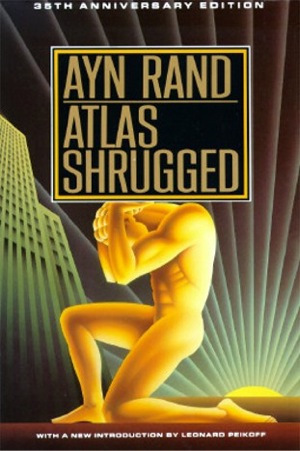
Book Review: Atlas Shrugged, by Ayn Rand

atlas_shrugged_coverIn this great nation of the United States, we have long maintained our democracy on a strict, two-party platform. In more recent times, these two positions have been filled by the left-leaning Democrats and right-leaning Republicans, but, aspiring to exercise to the fullest their rights as participants in the democratic process, smaller third parties have always managed to remain in existence. Among these more peripheral groups, one of the most prominent has long been the Libertarians who, in the opinion of this writer, offer a captivatingly stringent ideological adherence to the fundamental principles of liberty and small government.

Today’s brand of Libertarian represents a diverse membership, but many holding such a political ideology often cite in their political development one common influence. A Russian immigrant to the United States in the early 1900s, Ayn Rand, ceaselessly propagating her philosophy of objectivism, would later write one of the century’s most influential novels, an ideologically dense yet invigorating tale she named Atlas Shrugged, which appears to have become the gospel of the contemporary libertarian movement.

Set an ulterior, dystopian United States, in a world that is increasingly Marxist, the novel follows the events that surround Dagny Taggart, an executive of her family’s transcontinental railroad company. As her brother, James, the president of the corporation, increasingly engages in reckless and destructive business choices, seemingly sympathizing with the notion and proponents of a totalitarian state, Dagny becomes the real director of the company, attempting to extend its longevity to the greatest extent possible. Our protagonist finds solidarity with another rational man of business, Hank Rearden, president of Rearden Metal, whose innovative steel, the strongest and most durable of its kind, she utilizes for the construction of a new section of the Taggart rail network. Time progresses, and a trend of successful businessman leaving their corporations to fall into despair exponentially develops, yet Dagny and Hank fight on in their endeavor to merely remain above water.

While the world around them continues to grow grimmer and increasingly less hopeful, Dagny and Hank find one spark of hope in an abandon factory: a revolutionary engine that possesses the capacity to transform static electricity from the atmosphere into the energy needed to power a locomotive. Unaware of but desperate to discover the inventor of this engine, they embark on a quest that takes them to various places in a now hellish American country. Eventually, miraculously they find themselves in Galt’s Gulch, where they become acquainted with various figures, from business, medicine, art, and other important social spheres, including the aforementioned businessmen, all who have left their respective trades to join John Galt, with whom the reader, at this point in the story, is already somewhat familiar as the result of the novel’s widespread street phrase, “Who is John Galt?”

As the novel closes, the storyline wraps the mystery and uncertainty of why these people are present in Galt’s Gulch and what the future of the nation, and indeed the world, will be all together into a coherent, revelatory, and gripping ending, but that, as well as the answer to the question of Mr. Galt’s identity, is for you, reader, to discover for yourself.

In all verity, Atlas Shrugged is not an easy read. Its length alone might frighten some readers, but requiring even more mental faculty than that necessary to trudge through the nearly thousand pages is that required to pore the dense philosophical dogma that lies therein. Why, then, do I still maintain a positive opinion of and recommend this novel? The story is one that, though gripping, is even more so absorbing for its excellent use and conveyance of Rand’s beliefs. As it has affected countless others, Atlas Shrugged has similarly influenced my philosophical outlook and beliefs.

There will be those who will wholeheartedly disagree with Ms. Rand and her writings, yet the novel discussed here is worth the read even for the mental debate it will inevitably spark. If you are up for the challenge, as any good reader should be, and are open to intellectual growth, give Atlas Shrugged a shot.

-Sebastian R., 11th grade

Book Review: Teardrop, by Lauren Kate

Whenever I pick up a book with a gripping plot, action-packed adventure, and a swirl of romance, I feel like I’m in book heaven. That’s why I thought Teardrop (which is set to be published on October 22) would be an excellent book. Unfortunately, it fell short of my expectations.

Teardrop centers around a seventeen-year-old girl named Eureka who hasn’t cried since she was nine years old. When her mother dies in a car accident, Eureka turns emotionally unstable and suicidal. She misses her mother terribly and her only comfort is her best friend, Brooks. All she has to remember her mother by is a locket that is rusted shut, a special waterproof rock called a thunderstone, and a book written in an indecipherable language.

Eureka is followed by a mysterious blond enigma named Ander. He tells her that she is in danger. She decides to get her book translated by a woman who identifies the book to be about the lost island of Atlantis. The story tells of a heartbroken girl who cried until Atlantis was underwater. Eureka finds that the story is strangely relatable to her own life. To add to the unfolding mystery, Brooks begins to act hostile towards Eureka.

The puzzle pieces only begin to fit together after Eureka and Brooks suffer a near death experience and Brooks vanishes. Ander finds and tells her that she has the power to raise Atlantis with her tears. He also tells her that a previous inhabitant of Atlantis has possessed Brooks. Eureka is faced with life-changing choices as she is confronted and attacked by the Seedbearers, who will stop at nothing to keep Atlantis from rising again.

Although the idea of this book was extremely intriguing, I don’t think it was carried out very well. The plot launched into several promising directions, but didn’t follow through with most of them. However, there are a few pleasant qualities of this book. The characters are all very realistic, and the romance is electric. But the author spends too much time with minute details, and the bulk of the action is shortened to a few pages at the end of the book.

After reading Lauren Kate’s fantastic Fallen series, I expected Teardrop to be stellar as well. Admittedly, I may have set the bar too high. While Teardrop was only an adequate read, the rest of the series has great potential.

-Rabani S., 9th grade

This review was based on an advance reader’s copy generously provided by the publisher.

Book Review: Wildwood Dancing, by Juliette Marillier

wildwood_dancing_coverThis book review is part of series of reviews written by students at St. Margaret’s Episcopal School for their 7th grade English classes.

“The voice was deep and dark, like indigo velvet. A chill went down my spine” (114). But Night People aren’t Jena’s only concern this cold, medieval winter. Let me be the first to welcome you to the Wildwood, a wonderful, magical place that, every full moon, welcomes Jena and her four sisters to a splendid party. Juliet Marillier, an author from New Zealand who lives in Australia, weaves a fantastic and complex story of love, trust, family, and magic in her wonderful novel Wildwood Dancing.

Picture medieval Europe: a manor in Transylvania with an old castle surrounded by a feared forest and deadly lake called the Deadwash. Jena, the lead character, is the second eldest in a family with no mother and five daughters. She is brave, caring, strong, protecting, and clever. This winter, however, her father has to say good bye, leaving the girls to fend for themselves. All would have been well, save her dominating cousin Cezar. This evil and overpowering man poses the first of many conflicts to Jena. But Jena isn’t to fight them alone. Meet Gogu, a funny, smart, kind, loyal, loving, and talking frog. Well, not exactly talking. He talks into Jena’s, and only Jena’s, head. Many, especially Cezar, don’t approve of Jena’s choice of companion, but she won’t let him go for anything and their friendship grows to be key in the plot line.

Cezar and Jena have endured a tragedy that they still haven’t recovered from: the loss of Cezar’s big brother, Costi, nine years ago. Jena sees how Cezar has grown to be very vengeful, and his threat to cut down the forest and bring the Wildwood down with it had become scarily real on top of him taking over. Another growing threat is the Night People. There are many horrible stories and legends that surround these fearful creatures, and it becomes a deadly reality when a village woman dies- with bloody fang wounds in her neck. Tati, Jena’s gorgeous older sister, falls deeply in love with Sorrow, one of the Night People. This causes Jena more trouble, as her sister becomes distant, forgetful, and extremely devastated because she can’t see him. Jena realizes that if Tati goes with him, she will never see Tati again, but if she stays, she will continue to not eat and fade.

Throughout these many conflicts, many themes exist, but there are two main ones that I will share with you. The first theme is that standing up to others around may be hard, but it is rewarding. Jena and her sisters stand up to their cousin whenever they can, but is it enough to stop him? The second theme is to trust those you love and question when you are not in a trustworthy situation. Trust and instinct is an important part of the whole book, but you’ll have to read it to find out why.

This story is told from Jena’s point of view. Juliet Marillier uses this voice to be very descriptive and paint vivid pictures in the readers mind. Her expert word choice and careful structure make this book an amazing read. One of my favorite descriptive lines she uses is when she is describing the Wildwood when Jena visits, “Gowns and masks, robes and jewels filled the open space with a swirling mass of colors” (17).

If you want a deep, magical, amazing book to read, I recommend this book for you. Juliet Marillier will have you turning pages faster than ever. It is a great book for all young teenagers, with just the right amount of romance, action, and suspense for everyone. I really enjoyed this book, and finished it and the sequel in less than a week! It is truly a book everyone should be required to read. So if you want to find out to the gorgeous, love-stuck Tati, dominating, creepy Cezar, funny, loving Gogu the frog, and brave, kind Jena, read this fantastic book!

-Katherine S., 7th grade

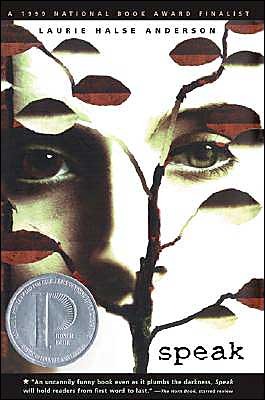
Book Review: Speak, by Laurie Halse Anderson

speak_coverHigh school should be one of the greatest experiences in freshman Melinda’s life, but instead it is twisted into a horrible nightmare as one secret rips her life apart. One party was turned into a complete disaster when she called the cops. However, there may be more than is seen on the surface.

Melinda finds herself rejected by her classmates and former friends, closed off from her parents, and unable to reveal the truth behind a trauma that has left her private and social life in ruins. As she faces more and more pain and harassment from school, she becomes increasingly isolated and soon refuses to talk at all. Melinda slowly loses touch with those around her, building walls around her to protect from the shame of what happened on that one fateful night. The safest place for her to be is her own head. But where can you run to escape from yourself?

Through her art class she finds some solace, and it is from an art project that she finally finds the  strength to face what really happened at that party– and this time Melinda fights back and refuses to be silent.

In this powerful Printz Honor novel, a realistic, believable heroine delivers a blow to the hypocritical world of high school with her ironic bitterness, and finally speaks up about her pain. She speaks for any teenager that feels like an outcast while demonstrating the importance of speaking up for oneself

Warning: This book may not be appropriate for children 12 and under due to mature content.

-Julia D., 9th grade

Book Review: The Final Four, by Paul Volponi

final_four_coverThis book review is part of series of reviews written by students at St. Margaret’s Episcopal School for their 7th grade English classes.

Being pushed around is an everyday occurrence on the courts of life and, most definitely, on the basketball court. This is particularly true in college level basketball during March madness of the NCAA tournament where it becomes a matter of survival. This spirit of survival is portrayed in Paul Volponi’s The Final Four when the Troy University Trojans are up against their toughest battle in the semi-finals against the Michigan State Spartans. The stakes are huge because whoever wins this game will move on to the finals and play North Carolina for the NCAA tournament championship. This heart-wrenching story showcases the influence of pride and how it can interfere with your relationships, the importance of courage on the court, and the value of loyalty to your teammates and coach.

Often times star athletes display extreme pride on and off the court. Malcolm McBride, the best college point guard in the NCAA, is a perfect example of a player who displays excessive hubris. This can be seen with his remark, “That’s why I wear eleven on my uniform. There are two number ones in a row” (14). Malcolm’s comment clearly shows his focus being only on himself at the expense of everyone else on the team. He regards himself not only as number one but also as a double one. His goal of reaching the NBA is the only thing that matters to him. As the author reveals more instances of Malcolm on and off the court, the reader begins to see how his rage increases, adding more fuel to the fire, when he exerts his emotions toward his teammates to convey that he is the only valuable player on the team. This excessive pride culminates with outrageous behavior when he targets a teammate, MJ (Michael Jordan), after Malcolm experiences a great tragedy in his life with his sister’s death. Malcolm’s relationships with his teammates set him up against his co-players due to his prideful nature.

In comparison, Michael Jordan is a benchwarmer who has low self-esteem and considers himself inferior to the other players. However, he has the willpower to change and the determination to grow. This can be seen when “MJ blocks out everything around him-Malcolm, the defenders, the crowd and even how much that one shot means” (232). As MJ’s skill level increases, his confidence rises, and he finds the courage to step up to the plate and become an exemplary basketball player. MJ’s self-esteem increases on and off the court and he has the courage to take a stand for himself because he is tired of being pushed around. This courage and tenacity propel MJ to become a leader and longer fear Malcolm McBride’s power on the court.

Furthermore, loyalty is shown when Malcolm McBride preservers through hardship, and reevaluates his behavior towards his family, teammates, and most importantly Michael Jordan. He learns the true meaning of trusting in one another rather than just himself. Also he is taught the importance of friendship and how much they endure for him. He also realizes that loyalty is a strong feeling of support or allegiance for someone. When he enters into the NBA he has to learn the importance of teamwork and reliability. Loyalty is expressed all throughout this book

The story illustrates that friendship and teamwork is far more important than just thinking about you. No matter who you are or what your situation, friends can and do make the difference in will make it a whole lot easier.

I really recommended reading this thrilling novel because, “Volponi has the rare gift of ratcheting up the intensity of the action off the court as well as on it” (Tim Green). Also this is a story of rivals battling it out and putting everything on the line to see who wins. It is truly a fight to the end. This book takes you through many twists and turns that deal with loss, humility, and truly learning how to be part of a team. And now, without further ado, the winner between Troy University and Michigan State is… Well, you’ll just have to read the book to find out.

-Jay P., 7th grade

Book Review: All-American Girl, by Meg Cabot

Top 10 reasons why people would love to read All-American Girl:
10. Samantha Madison, the main character, always does a “Top 10 reasons” explanation every couple chapters, which explain Sam’s problems in a clear and easy to read way.
9.Smart people and fans of National Geographic would like Rebecca, Sam’s twelve year-old genius sister, who has watched every episode of National Geographic.
8. Fashion lovers would want more of Lucy, Sam’s popular seventeen year-old sister.
7. Art lovers would adore Sam’s art school, friends who enjoy art, and the art competition Sam has to judge.
6. Girls looking for a romantic comedy would laugh and enjoy the romance story between Sam and a very comical yet attractive boy named David.
5. Teenagers with sibling problems would understand the crazy problems that Sam has to deal with because of Lucy and Rebecca.
4. Fans of the band No Doubt and Gwen Stefani would be thrilled that Sam is a fellow fan, too.
3. Citizens of America who are fans of the White House would be dazzled by the little-seen places of the President’s home.
2. Readers would love the comedy that Sam uses. For example, she gets invited to the White House for dinner and flushed her whole dinner down the toilet because she was a picky eater. Later, she ended up thinking that the next day’s headline would say something like this: MOST FAMOUS GIRL OF THE CENTURY CAUSES WHITE
HOUSE PLUMBING TO BLOW BY STUFFING ENTIRE DINNER DOWN TOILET.
1. Meg Cabot, the author, teaches a very important lesson that’s true for everyone.
What else would readers like about the realistic fiction book All-American Girl? Well, they would like Sam because:
  • She saves the President’s life, fascinating Americans with her loyalty and bravery
  • She teaches an important lesson that we should learn. Earlier, Sam always thought that it would great to be someone else, such as her favorite singer, Gwen Stefani, but she’s says in the end that “the number one reason I’m glad I’m not Gwen Stefani: 1. Because then I won’t be me” (Cabot 398).
Boys should be warned that since the main character is a fifteen-year-old girl born between two more girls, Sam isn’t aware that boys might read her story and openly talks about girl stuff, such as a girl’s private areas. Also readers should not do everything Sam does because she’s in love with her sister’s boyfriend and doesn’t pay attention in German class.
However, she proves that anybody can be a hero can be a hero, even a girl who mourns for the generation by wearing black and draws celebrity pictures in German class.
-Megan V., 8th grade

Book List: Books for a Roadtrip

road_trip_tim_lucas

photo by flickr user Tim Lucas

Most of us have been stuck in a car or a plane for an extended period of time. Maybe your family is driving to another state. Or maybe you want a good book to read by the pool. Either way, the books you choose to bring with you matter. Earlier this summer, I drove to Palm Desert with my family, and chose the following books to read on during the vacation.wrinkle_in_time

A Wrinkle in Time by Madeleine L’Engle is a book I read when I was younger. I’d always liked the odd, sci-fi aspect of the story, but after rereading it, I fell in love all over again! As a diehard science fiction fan, A Wrinkle in Time is sci-fi gold. The main character is a girl named Meg whose father works for the government as a scientist. When he disappears, she and her siblings look into what their father was working on when he vanished. Meg finds that he was working on a project about something called a tesseraect (a geometric figure used for space and time travel that’s also been referenced in The Avengers). Meg, her youngest brother, and a misfit boy from Meg’s school travel through space and time to find Meg’s father.

childhoods_end_coverChildhood’s End by Arthur C. Clarke is targeted to have an older audience. It isn’t exactly young adult literature, but it is a phenomenal story about an alien invasion in the late 20th century. The humans begin calling these creatures, which remain in their spaceships, overlords. The book itself has an odd format; it has three parts, no main character, and is written in third person omniscient. It’s an excellent book to read because you get to discover the mysteries of the overlords along with the rest of the human race.

uglies_coverUglies by Scott Westerfeld is about a fifteen year old girl named Tally Youngblood. It is set three hundred years in the future, and on your sixteenth birthday, you get an operation so that you can be pretty. Tally only wants to become a pretty and live where all of the beautiful people are. However, her friend decides she doesn’t want the operation and escapes to the wild. Tally is given an ultimatum: help a secret branch of government locate her friend and the rest of the runaways and bring them back or stay ugly forever. Tally embarks on a journey that changes her views of the world, and ultimately, her future.

Each of these books are considered science fiction, and even if you don’t care for sci-fi, these books are incredibly well written.

-Madison M., 12th grade

Book Review: Smoke

smoke_coverEllen Hopkins is one of my favorite authors so when I got a chance to read an advance copy of Smoke I knew I was in for a treat. Smoke is the squeal to Burned, which was published in 2006. Smoke continues the storyline of Burned in much the same format as the first, the one main difference being that  Smoke alternates viewpoints between Pattyn Scarlet Von Stratten, the protagonist of the first book, and her younger sister, Jackie.

For me the alternating viewpoints was the strongest point of the book. While Pattyn’s storyline does continue nicely from the first book I don’t think that the squeal would have worked as well as it did if it had been told strictly from her point of view. While the two sisters’ stories are separate in the sense that they are taking place in different parts of the country, they are still very much connected. I felt that Smoke really gave Jackie a chance to shine and be her own person as opposed to just a supporting character for Pattyn. It’s interesting to see how each sister responds to both being away from each other and dealing with the new lives they are forced to live because of the events that occurred in Burned.

The new characters introduced in Pattyn’s story line and well developed and it’s enjoying to follow Adriana, as well as the other new characters, as they spend time with Pattyn. Pattyn’s story line feels like a trip back in time in a way because of the migrant worker lifestyle she is living. This was one of my favorite aspects of the book because it’s not something that I typically associate with 2013 so it was interesting to see how it is still present today.

One thing that I think could have been better was that the story picked up very quickly, which while good in some aspects, left me a little lost for a while. The two books have a several year publishing gap between them which meant that as much as I loved Burned, some of its details had been forgotten by the time I got to read Smoke. Still this is a very minor thing that can easily be remedied by re-reading Burned before picking up Smoke.

Overall Smoke is an extremely strong squeal and I would highly recommend it to any fans of Ellen Hopkins. As with all Ellen Hopkins’s book this Smoke is best suited for older teens.

-Angela J., 12th grade

Book Review: The Wednesday Wars, by Gary D. Schmidt

wednesday_wars_coverNewberry Honor books are usually pretty good, but this one definetly wins top 10 on any of my reading lists. The writing was superb, the voice child-like but engaging, the character development definite, and the plot was riveting.

13 year old Holling Hoodhood knows seventh grade will be a nightmare when Mrs. Baker, his English teacher, hates him with a passion for no reason (most of us know that feeling, right?). But the world outside him is much worse than anything the two pet rats could cook up. The year is 1967 and the Vietnam War is raging. Every night on the news is a few more pictures of men crouching in bunkers, trying to survive.

But Holling has plenty of torture in store. Because he doesn’t go to the Jewish temple or the Catholic Church on Wednesday afternoon, he is stuck with Mrs. Baker who makes him read Shakespeare. But Holling soon notices an uncanny parallel between what is going on in his life and the plays he is reading. Eventually he doesn’t mind the Shakespeare. Even if it does end up with him in yellow tights on stage.

The character development of all the characters, even the minor ones in this book is huge and very rewarding. They all seem so alive and complex, which I think is one of the signs of a great author. The writing and the voice, which may be my favorite part, is very much like a 7th grade boy with a humorous outlook on life that reminds me of The Worst Best School Year Ever, by Barbara Robinson.

This book definitely made me think more about life but not in a boring way. I was always excited about what the next story would be and loved looking at life through Holling’s eyes. Everyone should read this book!

-Becka O., 9th grade