Manga Introduction: Black Butler, by Yana Toboso

black_butlerBlack Butler (aka Kuroshitsuji in the original Japanese) is a tale of a contract between a demon butler and a child in Victorian-era London…

After a dangerous happening in his childhood, Ciel Phantomhive is left an orphan with a demon contracted to him as a butler. The demon, named Sebastian Michaelis by Ciel, will take Ciel’s soul when Ciel’s goal is reached. Known as the “Queen’s Watchdog,” 12-year-old Ciel Phantomhive solves crimes at the Queens orders from mysterious deaths to insane nobles, while trying to reach is goal of avenging his family murder.

Black Butler is an simply amazing manga with wonderful drawings. Here are a few facts about this manga:

  • Published in September of 2006, it rose in popularity and is still popular today. It is also still being produced.
  • There are 19  tankobon volumes (manga books) with 4-5 chapters each. All of which are titled: “That Butler,_______”
  • The title Black Butler is used for the America, Germany, France, Italy and Spain releases while the original Japanese title Kuroshitsuji is used in the Japan, Poland, and Finland releases.
  • Published once a month by Square Enix in a magazine called Monthly GFantasy.
  • Has two seasons of animes as well as a OVA (original video animation). A live action movie was also produced and released this year. It also has had three two musical productions and a third run as a reprise of the second musical.

This is one of my favorites among the many mangas around. For one, this has simply incredible drawings.  The main character’s development during helps to bring much of the story together with a mix of trying to solve mysteries and the emotions and feeling that come with being a human.

This does contain demons, shinigami (death reapers), as well as many other mystical elements. It also contains many deaths and some other more gruesome happening due to some of the more insane characters included in the story. It also has a lot that deals with how human being act and why, which many be hard to understand. This is best for a slightly more mature audience.

I can’t decide everything so read it yourself and find the adventure waiting for you.

-Sarah J, 9th grade
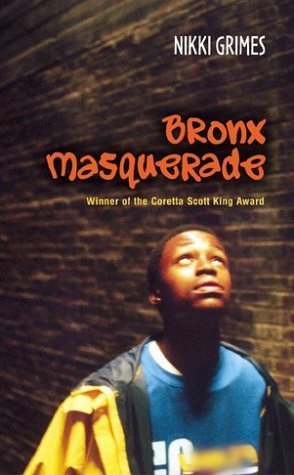
Book Review: Bronx Masquerade, by Nikki Grimes

bronx_masquerade
I never seemed to fit in…
People hate me…
No one understands who I really am…
They all think of me as something else, which is not who I really am…
I wish they could see me as what I am…

     Have you ever felt as though you didn’t belong because people judged you based on what you did and not on your true self? Don’t worry, it’s not just you. Devon, Shelia, Raymond, and fifteen other teenagers have felt it too. That is, until they took a class that changed their lives forever.
Their group of eighteen contains a teen mom, a shy artist, a girl who thinks that changing her name would change her identity, a really good basketball player, a guitarist preacher, a dyslexic, and many other people that are underestimated because of something about them. However, their high school English teacher convinces them to try out “Open Mike Friday,” where the class can go up and share a poem that they wrote. Soon, their stories unfold, first with a story through their view, them a short poem that shows the self beneath them.
One such poem explains the book perfectly, as it is by a jock who loves poetry, and wrote the title as Bronx Masquerade:

“…[T]here’s more to Devon than jump shot and rim… I dare you to peep behind these eyes, discover the poet in tough guy disguise. Don’t call me jump shot. My name is Surprise.” (Page 32)

I liked this book a lot, and felt overwhelmed with awe by the time I got to the end. It was well written, and Grimes had a creative style of presenting the plot, with a short story of one of the eighteen characters, then a poem written by them.
Additionally, the book sets a situation with kids who have some type of modern teenage problem, being anything from being way too pretty, to having a drunk dad who beats their child up. Either way, some kids could find comfort in this book, knowing that they found kids their age who share their feelings of a problem similar to theirs.
If you are a poetry fan or a poet yourself, there are more than eighteen poems in the book, all well written with a deep meaning.
Most importantly, these kids never gave up, even when their problems were at the peak of being the worst. The book teaches us to never give up.
I’d ask you to try it out yourself; you might feel a connection with one of the characters.
-Megan V., 9th grade

Book Review: Terrier by Tamora Pierce

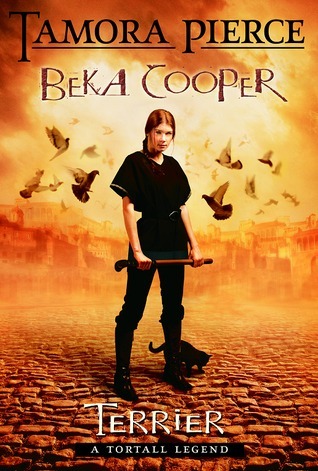
terrier“Rebekah Cooper. Your six-times-great-grandmother. Famed in her day for her service as a Provost’s Guard. She was fierce and law-abiding and loyal…”- An excerpt from Terrier by Tamora Pierce

Terrier, which is the first book of the Provost’s Dog series, is the fifteenth book of the many series set in the Kingdom of Tortall. Though this story starts many years before the first book, Alanna: First Adventure.

Rebakah “Beka” Cooper writes in her journal relaying the her tale of her training to become a Dog in the Provost’s Guard also known as the Provost’s Dog. In this era of Tortall, the city is divided into districts with the Provost’s Guards and the lawkeeper. She chose to train in the worst part of the city, the Lower City.  She is assigned to be Puppy(Dog in training) to the most renowned pair of Dogs in the city, Clara “Clary” Goodwin and Matthias “Mattes” Tunstall. She encounters many friends and foes in the Lower City as well as many crimes and mysteries. Beka come to discover a series of crime spread over years connected to an old bedtime tale about the Shadow Snake along with the mysterious appearance of the rare opals and the disappearance to the ones connected to it. Along with her help of her friend ghost carrying pigeons, and dust spinners, Beka pursues the answers to the mysteries.

Terrier is another wonderful tale by Tamora Pierce with a strong female protagonist. Compared to her other books this contains more of a mystery side to it. It also has less focused on what are the changes that come when growing up. Another difference is that this book is written in a journal style with different days being each chapter. Also due to the fact that it is a journal and Beka does come from a different time it has a special terminology. These terminology might be hard to understand at first but added to the character of the book. Beka is a well written character. With sharp senses and magic Gift, Beka seems to be a flawless character but she struggles with talking to others and her personality tends to lead her into sticky situations. This makes her more real to the readers.

This is only what I think of course, read it to decide for yourself.

In case you missed it, my other reviews of Tamora Pierce’s books:

First Test

Battle Magic

Alanna: The First Adventure

-Sarah J., 9th grade

Shakespeare? Or Nah?

shakespeare_or_nahNow, I know that a lot of you guys are hardcore literature lovers, and thus would be fundamentally incapable of comprehending why and how people could ever dislike the works of William Shakespeare. I know; frankly, I am right there among you.

But recently, I read about a study that revealed that only a small percentage of teenagers like/enjoy/appreciate Shakespeare’s works. To me, this is sad and disappointing, but I have also discovered it to be a hard, distinct truth of reality. Maybe this has something to do with the fact that students are forced to study his works in school and thus the requirement of doing so makes it unfavorable; maybe it has something to do with laziness, and not having the capability or attention span to dissect his extravagant use of language; or maybe because of all the modern, contemporary ways of passing leisure time, reading to comprehend the works of the Bard is an activity viewed upon as trivial, inconsequential, and pointless.

I wholeheartedly believe this to be untrue. For one, Shakespeare is an unprecedented phenomenon; no one since has been able to harness the English language as brilliantly as he did. We all know that his plays are world-renowned, but the real question is: Why should we choose to read Hamlet when we can SparkNote the play in candid, easy-to-understand, modern-style English in only a few precious seconds?

Michael Mack, an Associate English Professor from the Catholic University of America once compared reading Shakespeare to listening to music. As a self-proclaimed professional music listener, I declare this statement to be surprisingly accurate. The first time we hear a song we notice things like beat, repetition, genre, and whether or not we’d be able to dance to it. It is not until we have listened to the song many times that we begin to recognize the singer/songwriter’s message and start to discover the lyrics’ true meaning.

If you have never tried to read anything written by Will Shakespeare, I encourage you to pick up Romeo and Juliet (a story most everyone pretty much already knows) and read it in its original, non-abridged version. See if you like it. I hope you do. If you don’t, then I digress. I remain the type of person who (re)reads Shakespeare on the weekends for fun.

For those of you who have tried and not been able to navigate the Shakespearean language (no one blames you, trust me) there are also versions of the plays called “Shakespeare Made Easy” which includes the original and a modernized version of the text, along with explanatory footnotes that can be very useful, especially if you are reading for school. These are great reading tools and I encourage you to utilize them.

My advice: Defy society. Read Shakespeare in public.

-Danielle K., 8th grade

Book Review: The Young World, by Chris Weitz

young_world_coverFamous Hollywood screenwriter/director Chris Weitz has written his first novel, The Young World.   It is set in a world two years in the future and teens are the only ones alive and they are in control.  All of this was started by a sickness that killed everyone not experiencing puberty.  This is because of the special fibers created during puberty that keep the sickness at bay.  A group of teens living in Washington Square in New York have created a sort of community.  However, when the leader Wash dies from “the sickness” after turning 18, his younger brother Jefferson and four other teens, venture out of their community on a journey that may lead them to a cure.  This brings them on a wild adventure in which they face murderers, mole people, wild dogs, a bear, and cannibals.

Sci-Fi fans will love this book due to the post apocalyptic setting and show stopping action.  The cliffhanger will almost definitely lead to an intriguing sequel.

The book is written in first person but in the form of a movie script, which is no surprise because of the author’s twenty years writing and directing films such as Twilight: New Moon, American Pie, Antz, The Golden Compass, A Better Life, and the upcoming Disney movie, Cinderella.  I read my signed copy of this book in one day because I could not put it down.   I was lucky to hear him speak about his book last month in Mission Viejo where he told of his life in Hollywood and how this book came to be.

All in all, this is an excellent book and I highly recommend it to people who don’t mind violence, mild romance, and major cussing.  I recommend looking beyond the cussing to see the story for how great it is.

-Evan G., 6th grade

Event Recap: Chris Weitz Author Visit

On July 30th, director and now author, Chris Weitz debuted his brand new novel, The Young World, at the Mission Viejo Library.  He is the director of the Twillight Saga: New Moon and The Golden Compass.  Chris Weitz kicked off the event by letting us know how action-packed his book is.

young_world_coverThe Young World is a story about a post-apocalyptic world that is now being ruled by teenagers.  A strange sickness wiped out all of the population but left the teen survivors to fend for themselves and to possibly save all humanity.

Chris Weitz wrote this story for the YA audience.  He tried to keep his novel as original as possible and not to make it yet another dystopian themed book. The Young World, features a diverse set of characters– diverse in race and sexual orientation.  The story takes place in New York because Weitz knows this place very well.

At the event, we had a Q&A session and he told us that he found that it was particularly hard to get his thoughts down on the paper, especially during the tragic or sadder situations.  He also gave the audience very helpful advice on directing and acting.  Weitz read a small passage from his new book.  During this reading of the book listeners were already captivated  by deaths and emotional issues that will surely evolve in later chapters.   We got a glimpse of the narrators and were told of the teens’ favorite movie, Star Wars Most interestingly, Weitz made a very strong argument on how the word ‘like’ is actually a very necessary part of our speech. This book will for sure be an interesting read!

After he was done, we were able to get a copy of The Young World and I got it signed by Chris Weitz himself.  I am looking forward to reading this new book because it sounds very fun, witty, and interesting.

-Erika T., 8th grade

Short Story Review: The Offshore Pirate, by F. Scott Fitzgerald

offshore_pirateAfter reading both The Great Gatsby and This Side of Paradise, I decided that F. Scott Fitzgerald is one of my favorite authors.  While I do find some of the plots of his stories to be a bit slow at times, his writing style more than makes up for lack of action.

After checking out Flappers and Philosophers, a collection of short stories written by Fitzgerald, I flipped to the first story and was immediately hooked.  The Offshore Pirate is a story of youth, lust, and adventure.  Fitzgerald’s description of tiny islands off the coast of Florida are enchanting and beautiful.  If you guys don’t believe me, then take a look at this quote from the book:

“Taking her hand he led her out into a broad stretch of hard sandy soil that the moon flooded with great splendor. They floated out like drifting moths under the rich hazy light, and as the fantastic symphony wept and exulted and wavered and despaired, Ardita’s last sense of reality dropped away, and she abandoned her imagination to the dreamy summer scents of tropical flowers and the infinite starry spaces overhead, feeling that if she opened her eyes it would be to find herself dancing with a ghost in a land created by her own fantasy.”

Is that beautiful or what?  It is a short story, so I feel like giving out any of the plot would sort of ruin the adventure that is this book, so please just take my word for it.

If you like writing that will make you feel warm and fuzzy and magical inside, read The Offshore Pirate!  It only takes about an hour to read (if you’re a sloth-speed reader like me) and is more than worth the sixty minutes.

-Amanda D., 12th grade

Book Review: The Da Vinci Code, by Dan Brown

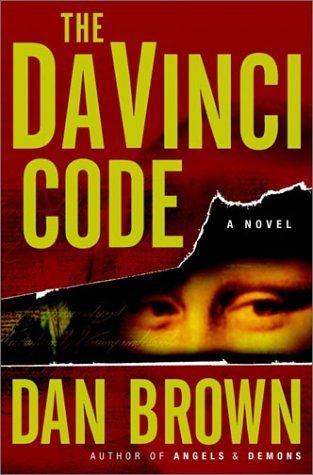
davinci_codeA book that became highly popular years ago, this is a title that many have heard of, but one that few teens from this generation have actually read.

The overall verdict: this is a book that either you will either fall in love with, or that you will hate. It’s rare to find an opinion in reviews that begs to differ.

In my opinion, it was a fast-paced page turner that kept me engaged and relatively entertained during the span of time that I was reading it, but there were still many holes that left me unsatisfied with the book as a whole with its completion.

The basic plot traces the story, both in a modern fictional account and in a “historical” context, of the search of the true holy grail-not only a treasure of time and religious history, but also one of deeper metaphorical symbolism. To provide a more in depth synopsis: a murder within the Louvre in tangent with clues hidden within the works of the great master Leonardo DaVinci (along with many other renowned thinkers and artists) leads to the discovery of a religious enigma hidden by a secret society for thousands of years, a secret that could cause catastrophic change in the base of worldwide religion.

Sounds a bit overdramatic with a dose of being formulaic, doesn’t it?

Brown weaves a fast-paced and entertaining read that leaves you with cliffhangers at every chapter’s conclusion, leaving you flipping the pages till the end. Read as a shallow summertime read is a good investment, however reading too deeply into the “historical facts” may prove dangerous. Taken as pure fiction many of the “historical facts” serve as fascinating concepts for future introspection on secrets societies, treasure, and religion as a whole-taken as fact; however, many prove to be a stretch. Brown treads a thin line in his historical accuracy, writing a story of fiction, but stating many of the facts as the complete truth when transferred over to our world. The main warning: read with a grain of salt.

The plot also leaves you with too many twists to count- one of the most entertaining aspects for me. One moment an ally seems like a foe, the next it is revealed who in fact the true enemy is, and the moment directly after it turns out that one of the main antagonists was actually good all along! (You get the point.) It serves to be highly entertaining, but by the third plot deception it leaves you wondering how much of a formula Brown had at his disposal, and if he really did intend to be so repetitive.

Another thing that particularly struck me was the fact that many of the plot occurrences seemed just too perfect to conspire in real life. Many aspects of the novel proved to be highly unrealistic, a romance where one would never take place in real life, the fact that one of the main emulated ideas in the story is that of a scared and empowered feminine-yet the main (and only) female protagonist is, although being portrayed as smart and beautiful, is forced to act powerless for large stretched in the plot, and that somehow the protagonists always end up where they were supposed to with the answer they needed in the end.

Overall, the writing isn’t terrible-it is just a story that one must read with the intent of entertainment, not fact.

-Sophia U., 12th grade

Book Review: Ruby’s Slippers, by Tricia Rayburn

rubys_slippersRuby’s Slippers by Tricia Rayburn is a realistic-fiction novel depicting a girl named Ruby moving all the way from rural Kansas to Florida because of a grandmother she barely knows.

Ruby Lee, who had never heard of Facebook, seen a video on YouTube, or downloaded a song from iTunes, is suddenly thrust into Coconut Cove where her new school is much nicer compared to her old one back in Kansas. The school is about ten times bigger and has a very nice auditorium.
On the first day of school she does not only manage to embarrass herself with a metal lunchbox, but also manages to make enemies with the most popular girl in school, Ava Grand.

Despite the trouble of being the new kid at school, Ruby also has to prepare for the upcoming talent show, Citrus Star, where participation is mandatory. Not having any friends, Ruby is unable to partner up with anybody. Miss Anita, the school’s performance director, helps Ruby join the dancing group Constellation. Ruby is thankful for her help, but her relief is eradicated when she realizes who is in the group- Ava Grand and three of her friends. Going to her first rehearsal, Ruby begins to have fun against all expectations. I do not want to give away the ending, but it has a surprising twist I did not see coming.

Overall, the book was decent. There were both pros and cons in the book, especially with how Ruby handled different situations. For example, I liked how Ruby supported her Mom when she was looking for a job. Although, I did not like how Ruby was completely clueless in some situations in the story, that she could have easily handled. At the same time, I did not like how sometimes in the book, the author took time to describe simple things. On the other hand, I felt like the ending was good and gratifying. This book is great for kids aged 9-12.

-Anmol K., 7th grade

Book vs. Movie: The Fault in Our Stars

fault_bookvsmovieJust as a header- If you haven’t read and seen The Fault in Our Stars, this review might spoil a few things.

The Fault in Our Stars by John Green is an amazing book, teaching us many life lessons that we should keep with us forever. Be grateful for what you have; both of the main characters, Hazel Grace and Augustus Waters, have cancer. Cancer is a life-threatening disease, which for some reason always touches the human heart in a way that is indescribable. Hazel Grace and Augustus Waters go on an amazing ride, a rollercoaster that only goes up. As readers, we get to experience their amazing journey along side of them, staying with them when they fall in love. Every book has its tragedies, and so does this one. This book is quite a memory; it makes you feel as if this was your life. I will never forget this book.

Recently, a movie interpretation of this book was made, and it kept quite close to the actual book’s plot. Although the movie missed some aspects of the novel, it skipped ones that were really not that important to the progression of the story. The movie lacked the story of Augustus Waters’ ex-girlfriend, who also died from cancer. In the novel, Hazel finds out, but doesn’t do much of it aside from visiting the web page of his girlfriend, and seeing how and by who she was missed. However, this is one minor detail that needn’t be included in the story. On the other hand, the movie was surprisingly similar to the novel. The film kept in mind the novel’s little details, so much so that they even had a bright green sports car as Monica’s car just as in the novel.

In general, The Fault in Our Stars by John Green is a masterpiece that has simply been put into words and onto sheets and sheets of paper.

-Nirmeet B., 10th grade