Lord of the Flies by William Golding

William Golding’s Lord of the Flies is a novel about a group of young boys who have been stranded on an island, without any connection to civilization. They struggle to maintain order and peace on the island, as the group becomes split between two “tribes:” a violent, uncivilized tribe, and a more rational tribe dedicated to becoming rescued.

The novel begins with the boys recovering from an airplane crash. The boys discover that they are stranded on the island alone, without any grownups or methods of communication with the outside world. Ralph, a boy approximately twelve years old, befriends an intelligent, but physically weak boy nicknamed Piggy. Together they find a conch at the beach, which they blow into to rally all the other boys scattered about the island. The boys all decide to vote Ralph as “chief” since he possess the conch, infuriating Jack, who leads a group of choir boys and wants to lead all of the boys on the island.

Despite their struggle for power, Jack and Ralph initially get along, and they focus the group’s efforts on building a signal fire to contact ships for rescue and shelters for survival. However, the two being to drift apart as Jack begins hunting. Hunting causes Jack to reveal his more savage and violent nature, causing him to become less focused on the group’s priorities, which is mainly getting rescued. Furthermore, the group begins to collapse even further as they discover that there is a “Beast” who watches over their signal fire, panicking all the boys.

Ultimately, the Lord of the Flies is a classic novel, and I would highly recommend it. It is relevant today because of its themes on human nature. It reveals that despite what people appear like, beneath that civilized mask is violence and savagery, uncovered when people are forced away from civilization. The novel focuses on the boys struggle to remain order and peace as they drift apart.

-Josh N. 

Lord of the Flies by William Golding is available for checkout from the Mission Viejo Library. It is also available for download from Overdrive

The Call of the Wild by Jack London

The Call of the Wild: Jack London: 8580001049755: Amazon.com: Books

The work tells the story of Buck, a pet dog of Judge Miller’s family, who has been living in a warm valley in southern California after being civilized. He was sold to the cold, remote, gold-rich northern state of Alaska as a sled dog. The dog who should represent the civilized world as a dog is forced to return to barbarism by his master. Growing up in a greenhouse, Buck was stolen and sold to the wild as a sled dog. The cruel reality touched Buck’s instinct and consciousness of returning to nature due to the long influence of human civilization. Buck was trained by the harsh living conditions, and he grew through them. In the end, he won the first place in the sled dog pack by defeating the king Spitz. When the cruel Hal had beaten Buck black and blue and was almost dead, John Thornton’s rescue made Buck feel warm and decided to pledge his loyalty to his patron to the end. However, the death of the benefactor completely broke Buck’s attachment to human society, so Buck was determined to go to the wilderness and return to nature.

First of all, the image of the dog in the novel is in sharp contrast to the image of the human. Dogs (Buck) are brave, kind, loyal, grateful, highly adaptable, and have excellent leadership skills, while humans are mostly hypocritical and tyrants. Buck was sold to a dog dealer and moved from the comfort of Judge Miller’s home to the rigors of northern life, but he soon adapted to the rules of existence. Even if there were no foreboding in the air, he could dig a hole by a tree or a bank, and hide safely from the strong wind. Buck used the best of management to keep the dogs in order. It pulled up a thousand pounds of flour and won the bet. Humans, on the other hand, still treat dogs with ropes, cages, and sticks. To satisfy their own desires, they do not care about the fate of other creatures. Man thinks he has the right to truth, and he thinks he is the supreme master of the dog. It is just because of a series of selfish behaviors of human beings that lead to the tragic fate of the dogs, and at the same time, human beings also suffer bad consequences. Hal and his family are buried in the White River, and Buck finally returns to the wilderness.

-Coreen C.

A Time to Kill by John Grisham

This is a legal thriller written by former criminal defense attorney John Grisham. The reason I thought that the first novel written by him is awesome is because it not only penetrates deep into the entrenched system of racism in America, it also describes the love and duty of a father. Carl Lee Bailey murdered brutally the rapists who harmed his twelve year old daughter teaches me how much a father can do to protect his little girl. Moreover, it also tells me how unfair the justice system was to blacks in general compared to whites. I was also very shocked at the Ku Klux Klan and how cruel they can be in terms of killing innocent African Americans and burning any traitors at the cross.

This novel serves as a reminder to people working in the legal professions today on how our justice system should conform with the foundation of democracy—racial equality. It also delivers a message to its readers in that laws can be interpreted in different ways and we should have sympathy for each other. Supposedly, Carl Lee Bailey should be charged with capital punishment, but because he killed the two rapists for the sake of his daughter, he was released at last. The jurors knew that every father would perhaps do the same for their own daughter, which is the reason they decided that Bailey was not guilty.

-Coreen C. 

A Time to Kill by John Grisham is available for checkout from the Mission Viejo Library. It can also be downloaded for free from Overdrive

Authors We Love: Mary Flannery O’Connor

Flannery O'Connor (Author of A Good Man is Hard to Find and Other ...

Flannery O ‘Connor was born in Savannah, Georgia, and graduated from Georgia Women’s College and the University of Iowa. She is a Catholic American novelist, short story writer, and critic. O ‘Connor has written two novels, 32 short stories, and numerous book and film reviews. O ‘Connor is a southern writer whose works have a southern Gothic style and rely heavily on regional settings and grotesque characters. O ‘Connor’s work also reflects her Roman Catholic beliefs and often examines questions of morality and ethics. O ‘Connor’s “The Complete Stories” won the National Book Award in 1972, posthumously, and was hailed by online readers as “one of the best American National Book Awards of all time.” Flannery O’Connor is said to have taught her favorite dwarf chicken to walk backwards when she was five years old. The stunt caught the attention of Pathe Studios, and a cameraman from the North was sent to O ‘Connor’s backyard in Savannah, Georgia, to record the stunt. O ‘Connor never saw the funny film, although it was shown in many American cinemas in 1932.

By The time she wrote “The King of The Birds” in 1961, O ‘Connor was a literary and artistic celebrity with a cult following. She made her name by publishing two novels — “Wise Blood” and “The Violent Bear It Away” and “A Good Man Is Hard to Find. Newsweek magazine featured a photograph of O ‘Connor’s pre-World War II home in Milledgeville, GA. Harper’s Bazaar has a rather glamorous portrait of O ‘Connor while her work has also been featured in Vogue. In her work, O ‘Connor depicted the American South. Set mostly in the rural South, “A Good Man Is Hard to Find” features at least four main characters — a widowed, conservative old lady and her unsociable daughter — living on a farm. These characters probably have something in common with O ‘Connor and her mother. As time went on, people began to notice that O ‘Connor herself was a devout Roman Catholic, and that her novels seemed to have something to do with religion. In the writings of a collection of essays and a collection of letters published after her death, O ‘Connor not only makes clear her own religious beliefs and the crucial role they play in her work, but also makes detailed interpretations of some of her own novels.

-Coreen C.

Wise Blood by Flannery O’Connor

Wise Blood by Flannery O'Connor

“Wise Blood”, the first full-length novel by American writer O ‘Connor, is a religious fable discussing salvation through faith. “Wise Blood” is set in The city of Taulkinham, Tennessee in the mid-20th century. The protagonist Hazel Motes tries to eradicate the influence of Jesus on him, and takes a path of spiritual disillusionment and conversion mixed with sadness and joy, which ends in failure. Hazel Motes, the protagonist, grew up in a family of village ministers and wanted to become a priest, just like his grandfather. His faith wavered during his years abroad as a soldier, and after his demobilization he tried to cast off his religious convictions. In Taulkinham, Hazel meets Hawks, a pseudo-believer who preaches-disguised as a blind man, his illegitimate daughter Lily, and an 18-year-old boy named Enoch. Hazel spoke to everyone about blasphemy as the only way to achieve truth, and publicly promoted a Protestant religion without Jesus. However, the public was indifferent to his words, and the Protestantism he preached was exploited by Hawks as a money swindler. After driving over Hawk’s fake prophet, Hazel blinded himself and fell into a gutter on a stormy night.

Sin and redemption are the most important themes in O ‘Connor’s novels. In “Wise Blood” with strong religious color, both the narrative structure of the Bible and the image of the Bible are cleverly borrowed to highlight the theme of sin and redemption. The title “Wise Blood” symbolizes original sin in the Bible, and human beings are born with sin, which is also one of the most critical kernels in the humanistic concept of the Bible. In “Wise Blood”, Hazel’s sins are realized through violence. Violence against others became a means for Hazel to rebel against God. At the same time, he blinded himself with lime, tied himself with wire, and put on shoes filled with stones. Such violence against himself became a means of self-redemption. Hazel’s physical torture meant the death of his sins, bringing him back to the faith of his childhood, and giving him grace. The two world wars completely disillusioned people’s dreams, vanity of pleasure behind the appearance of concealing the human selfish hypocrisy, empty spirit, and withered soul. These people are immersed in the mire of crime and do not know, mankind is facing an unprecedented crisis of faith. O ‘Connor wants to make those who believe that God is dead realize their own defects and sins through violence.

-Coreen C.

The Help by Kathryn Stockett

The Help by Kathryn Stockett is a heart-wrenchingly beautiful novel about patience, faith, and the transcending power of love.

The novel focuses on three main characters and their intertwining stories. Aibileen Clark is an African-American housekeeper in 1960s Jackson, Mississippi. Tormented by her mistress and haunted by her son’s recent death, Aibileen begins to seek change. Minny Jackson is Aibileen’s best friend. She’s been fired from job after job because of her smart mouth. With five mouths to feed and an abusive husband, Minny is hardened and bitter. However, when she goes to work for Celia Ray, she discovers something new. Eugenia Phelan has been different her entire life. She’s never exactly fit in with her parents’ wealthy, white friends: she longs to be a writer and find true love on the side. As she navigates the treacherous minefield of high society and tentative love, she meets Aibileen and Minny, and the three unite to write a book that may very well get them killed.

The Help is about so much more than the complicated race relations in the mid-90s South. At its heart, it’s a coming-of-age, an opening-of-heart story. Over the course of the plot, the three women learn to find themselves in the blank noise of society, to stay true to themselves when everyone else is telling them to lie. At the end of the day, that is what the novel is about. The enormous power of opening your heart and mind is realistically and hauntingly portrayed here. The hauntingly heartfelt writing style employed by Miss Stockett is perfect- the book reads like a letter written to an old friend. This is a thought-provoking novel that will elicit tears and laughs in equal measures.

-Vaidehi B.

The Help by Kathryn Stockett is available for checkout from the Mission Viejo Library. It can also be downloaded online for free from Overdrive

Authors We Love: Ernest Hemingway

Ernest Hemingway (Author of The Old Man and the Sea)

Ernest Miller Hemingway (July 21, 1899 — July 2, 1961) was an American writer and journalist who lived in Oak Park, a suburb of Chicago, Illinois. Hemingway won many awards during his life. He was awarded the silver medal for bravery during World War I. In 1953, he won the Pulitzer Prize for the Old Man and the Sea, which won him the Nobel Prize for Literature in 1954. In 2001, Hemingway’s The Sun Also Rises and A Farewell to Arms were included in The American Modern Library‘s list of The 100 Best English Novels of The 20th Century. Hemingway was a representative figure among the “Lost Generation” writers in the United States. In his works, he showed confusion and hesitation about life, the world and the society. He has always been known as a tough guy in the literary world, and he is the spiritual monument of the American nation. Hemingway’s works mark the formation of his unique style of creation, and occupy an important position in the history of American and world literature.

Ernest Hemingway was born in Oak Park and was baptised at Walloon Lake. Hemingway spent most of his childhood in his farmhouse at Walloon Lake, reading picture books and animal comics and listening to all kinds of stories. He liked to imitate different characters and was interested in sewing and other domestic things. Hemingway’s mother wanted her son to pursue a musical career, but Hemingway followed his father’s interests, such as hunting, fishing, and camping in the woods and lakes. So Hemingway, who grew up in a farmhouse on Walloon Lake, loved nature. From 1913 to 1917, Hemingway received high school education, academic performance, physical education, and an outstanding talent in English. He got his first writing experience in junior high, writing for two literary newspapers. When he entered high school, he became the editor of the journal. He sometimes uses the name Ring Lardner Jr in honor of his literary hero, Ring Lardner . After high school, Hemingway, rejecting college, began his writing career at the age of 18 as a reporter for the Kansas City Star, an influential newspaper in the United States. During his six months working for the Kansas City Star, Hemingway received good training.

In 1918, despite his father’s opposition, Hemingway quit his job as a journalist and tried to join the U.S. military to observe the fighting in World War I. Hemingway failed the physical examination due to a visual defect and was transferred to the Red Cross ambulance team as an ambulance driver. On his way to the Italian front, he stopped in Paris under German bombardment. Instead of staying in a safe hotel, he kept as close as he could to the battle. Hemingway witnessed the cruelty of war on the Italian front, shocked by the explosion of an ammunition depot near Milan and the fact that more women than men died in a makeshift morgue. Hemingway was awarded a silver medal for bravery by the Italian government on July 8, 1918, when he was wounded while transporting supplies and dragged the wounded Italian soldiers to safety. Later, Hemingway worked in an American Red Cross hospital in Milan. It was the inspiration for his early novel A Farewell to Arms. Hemingway regarded himself as the protagonist of the novel, the original creation.

In 1920, Hemingway moved to Toronto, Ontario, where he lived in an apartment. While there, Hemingway took a job with the Toronto Star as a freelance writer, reporter, and overseas correspondent, and struck up a friendship with Morley Callaghan, a star reporter. Between 1920 and 1921, Hemingway lived near Chicago’s north side and worked for a small newspaper. In 1921, Hemingway married his first wife, Hadley Richardson, and moved to a three-story apartment on the North side of Chicago in September. By December, the Hemingways had moved out of the country and never returned to live there. Ernest Hemingway, settled in Paris, gave an interview to the Star newspaper about the Greek-Turkish War (1919-1922). Back in Paris, Anderson guided Hemingway into the “Paris Modernist Movement.” Hemingway’s first novel, “Three Stories and Ten Poems,” was published in Paris in 1923. After the birth of his first son, Hemingway quit his job at the Toronto Star to support the family.

In 1925, the short story series In Our Time was published, showing a concise style of writing. 1926 Hemingway’s novel The Sun Also Rises was published. In 1927, Hemingway divorced Hadley Richardson and married his second wife, Pauline Pfeiffer and published Men Without Women. Hemingway left Paris in 1928 to live a quiet idyllic life in Florida and Cuba. He often goes hunting, fishing, and watching bullfights. Within a few years, Hemingway’s second and third sons were born. In 1931, Hemingway moved to Key West (where he lived in a house that is now a museum) and gathered material for Death in the Afternoon and Winner Gets Nothing. Death in the Afternoon was published in 1932. In 1937-38, he worked as a war correspondent on the front lines of the Spanish Civil War. During World War II, he went with the army as a journalist and fought in the liberation of Paris. During this time, Hemingway’s essay “Denouncement” was published in 1969 with “The Fifth Column and Four Stories of the Spanish Civil War.”

Hemingway and Pfeiffer’s marriage ended in 1940. During this period, physical health problems came one after another, causing great trouble to Hemingway. In the same year, Hemingway published For Whom the Bell Tolls, an anti-fascist novel set in the Spanish Civil War, and in 1950, Across the River and into the Trees, set in Venice after World War II. After the Pacific War broke out at the end of 1941, Hemingway immediately converted his yacht into a patrol boat to monitor the operations of German submarines and provide information for the destruction of the enemy. In the mid-1990s, Alexander Vasiliev, a former KGB officer, was granted access to Soviet intelligence archives. He was surprised to discover that Hemingway had been recruited as a KGB spy in 1941, codenamed Argo. Unfortunately, he had no talent for obtaining any valuable information.

In 1944, Hemingway accompanied the American army to Europe for an interview. He was seriously injured in a plane crash, but after recovering, he still went behind enemy lines for an interview. After the end of the second world war, he received a bronze medal. Hemingway divorced Martha in 1948, married Mary Welsh Hemingway, a wartime correspondent, and returned to Cuba shortly thereafter. Hemingway took his own life with a shotgun in Idaho on July 2, 1961, at age 62. Hemingway has an excellent command of language. He often employs the simplest words to express the most complex content, basic words and short sentence patterns to express the specific meaning, nouns and verbs to reveal the true colors of things without any affectation. Hemingway’s life and literary career were controversial from the start. Hemingway, whether as a legendary figure or as a writer, created a concise and smooth style with his unique artistic style and superb writing skills, which purified the traditional style of writing of a generation and had a great impact on the European and American literary circles.

-Coreen C.

TV Show Review: Seinfeld

I’ve only seen the first two seasons of Seinfeld so far, but I’m greatly enjoying the show.

Jerry Seinfeld, the main character, is a stand-up comedian who lives in New York. Many of his performances are inspired by events or people in the show, and we get to see these performances at the beginning, middle, and end of each episode. The three other main characters are George, Elaine, and Kramer, who lives in the same apartment complex as Jerry and frequently pays him visits. Jerry and his friends are always making comments about the strange habits of humans no one else seems to address.

Since the show takes place in ’90s New York, it’s interesting to see the difference in style in terms of hair, technology, clothing, and more.

What I like about the show is that it’s very light-hearted and entertaining. There’s no real plot to the series, but that’s what makes it fun. For instance, the entirety of one episode takes place in a restaurant. However, it’s far from boring. The characters and the jokes keep the audience interested and amused.

Though the show might seem similar to Friends since both shows include single characters living in New York, the differences in characters, story, and humor set them apart from each other. Unlike Seinfeld, Friends has a more complex plot and I think the characters have more complicated relationships with each other (although, as I’ve only seen the first two seasons of Seinfeld, this might change). However, I still enjoy both shows!

I would suggest the show to fans of Friends and The Office, or anyone looking for a TV series that is light-hearted and comforting.

– Mia T.

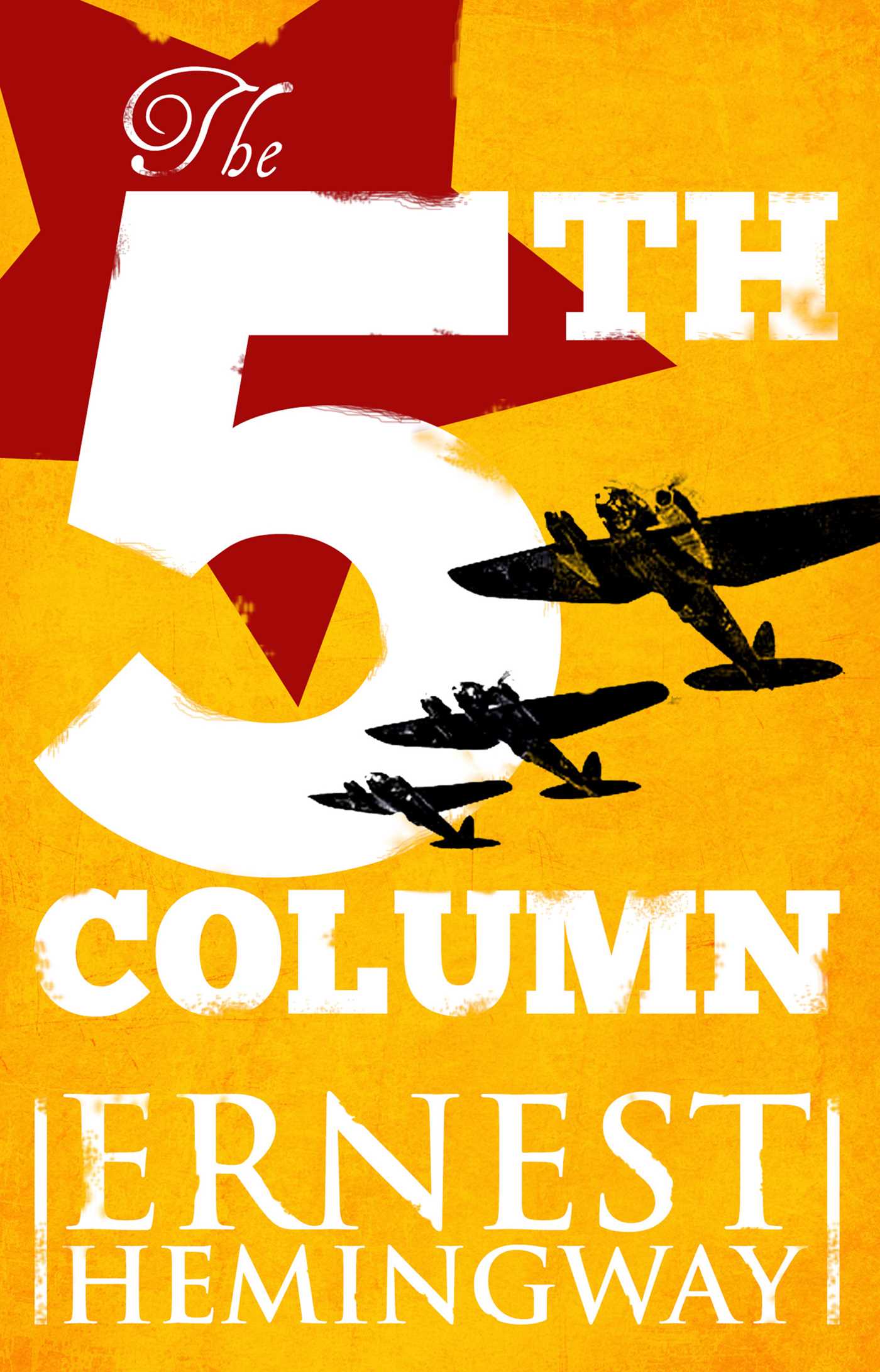
The Fifth Column by Ernest Hemingway

Fifth Column eBook by Ernest Hemingway | Official Publisher Page ...

The Fifth Column is a play by American writer Ernest Hemingway, first published in 1938. The play tells the story of Philip Rawlings, an active, attentive warrior at night, though ostensibly a bystander with no connection to Spain. This play is the only one that Hemingway wrote in his whole life and has a strong autobiographical character. Rawlings, the hero, was based on Hemingway. The Fifth Column is a three-act play depicting the Republican government in Madrid besieged by Franco rebels during the Spanish Civil War. An American, Philip Rawlings, and a German, Max, sent by the Republican government security service to spy bravely on the rebels, capture an important prisoner, and then let him escape.

Many fifth column members were subsequently captured. Under severe torture, they confessed their accomplices, and three hundred others were arrested. Rawlings and his assistant Max eventually break up the rebel spy ring in Madrid’s fifth column. In time of peace, everyone’s life is equal, and no one can deprive another person of the right to live. But when the smoke of war is in the air, it is easy to form a disorderly ethical environment. Especially when the unjust party temporarily wins, they do not care about ethics at all, but enjoy the privileges brought by the victory of war and indulge their desires to do whatever they want.

The evil side of human nature is concentrated. Hemingway’s writing has a special style, that is, colloquialism. It is in these seemingly plain colloquialisms in his novels that the atmosphere of the story is profoundly delineated, as is also the case in The Fifth Column, where the story appears to be simple, but the ups and downs of the characters are clearly revealed in the spoken language. The play focuses on Philip’s love affair with Dorothy, the daughter of a middle-class American, who is vain and incompetent. In the end, Philip gave her up for his political convictions in favour of a grisly Moorish woman. From Dorothy’s characterization, it is clear that Hemingway has begun to use the rich but insatiable American female as a symbol of a hostile class in The Fifth Column.

-Coreen C.

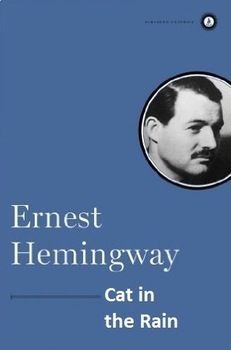
Cat in the Rain by Ernest Hemingway

Cat in the Rain - Ernest Hemingway - listen online for free

One rainy day an American couple visiting Italy stayed in their hotel. The husband was reading in bed and the wife was standing by the window looking out at the view when she came across a cat crouched under a dripping green table. In a spirit of compassion, the wife decided to carry the cat back to her room in the rain. But when she got down, the cat was nowhere to be seen. The wife returned to her room in great disappointment. A maid was standing at the door with a large tortoise-shell cat, which the landlord had given to her wife.

The novel comes to a screeching halt, leaving the reader with plenty of room for imagination. Cat in the Rain is one of the few short stories that reflect female consciousness. In this novel, the heroine does not have a name, but the author gives her different titles in different situations. This paper analyzes the desire and awakening of the female subject consciousness of the hostess princess in the patriarchal society from the perspective of appellation. It embodies Hemingway’s simple narrative style and implicit stylistic characteristics.

The novel was written in the early 1920s, when the status of women in the United States was undergoing great changes. The new women redefined their roles in the family and society. They demanded to be equal to men and no longer played the roles played by traditional women who were sheltered and subordinate to men. In fact, the new women are more like men, looking and acting like tomboys: they wear short hair, short skirts, play golf, drive cars, smoke, and drink like men. They are open-minded, enthusiastic and pursue fun. Cat in the Rain fully reflects Hemingway’s profound thinking on the status of women in the family and society under the background of that time.

Cat in the Rain is one of Hemingway’s few works with a female protagonist. In this novel, Hemingway delicately described their inner desires, anguish, needs, words, and deeds from the perspective of women, conveying the subordination of women in the patriarchal society and their strong desire to change the situation. Even with the gradual awakening of their self-consciousness and their struggle against the society, the theme of women in the works is more implicit, profound, and thought-provoking, implying Hemingway’s understanding and attitude towards women.

As a nameless woman in ordinary life, the American wife has no choice and no ability to choose between inner needs (desires) and external temptations during the journey of life, so she can only create an unreal world for herself to seek temporary satisfaction through whispering. The reason why women have a special liking for cats is determined by the specific aesthetic characteristics and perceptual requirements of women under the social conditions at that time. A woman and a cat are naturally linked by her natural maternal instinct and compassion. Cat in the Rain inspired the American wife’s desire to find the lost self, which was the inevitable result of women’s understanding and thinking about their own destiny.

-Coreen C.