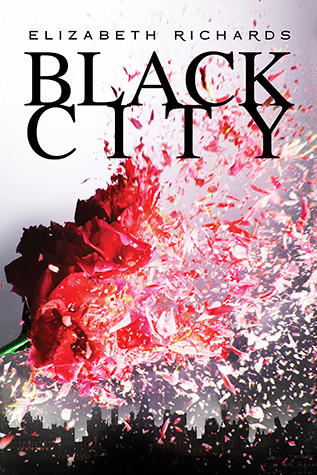
Book Review: Black City, by Elizabeth Richards

black_city_coverI absolutely love this book! Richards portrays two teens who have hated each other at first sight. Natalie Buchanan is the daughter of the Emissary and a human. Ash Fisher is a half-blood darkling who just about thinks only of himself and is a complete jerk to everyone. In the United States Sentry, huge tension is present between the two races as well as a huge wall that separates the two communities.

All Ash has ever known is the cold stillness of his never-beating heart, when one day his heart starts to boom in his chest. Natalie then finds herself swept off her feet and in love with last person she wanted to be with, and the two find an amazing discovery: they are soul mates and have fallen in love. The struggle to pretend their hate for each other becomes difficult each day because all they want to do is be together.

War soon starts to break out among the two races as they struggle to survive. A disease called the Wrath has fallen upon the darklings who are spreading it to the humans through haze dealing. As the two put aside their differences and fight to unite the races Ash and Natalie soon realize that they have just put their lives on the line. Will they be able to save their people or not?

You are just going to have to read it to find out. When I started reading, it was as if my eyes were glued to the pages. I just couldn’t put the book down and I hope it does the same for you. Enjoy reading Black City everyone!

-Christina B., 7th grade

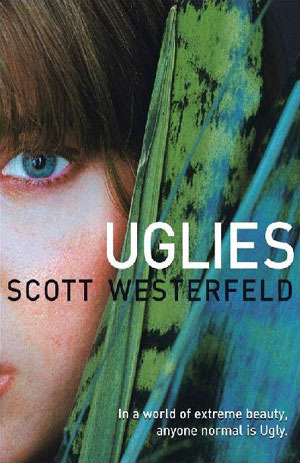
Series Review: The Uglies Saga, by Scott Westerfeld

uglies_coverLike many science fiction book that are being published these days, Uglies by Scott Westerfeld is centered around a teenage girl. The Uglies Saga has glamour, romance, and action compacted into four books. The books are appropriately titled: Uglies, Pretties, Specials, and Extras.

The series is set in a world three hundred years in the future. There is more focus on nanotechnology, which manipulates matter. This leads to new inventions, such as hoverboards and rotating apartment buildings (so that its residents will never get tired of the view). The populations is categorized into three groups. There are littlies (who live with their parents until they are twelve), uglies (who live in a dorm until they are sixteen), new pretties (live in New Pretty Town and have no worries), middle pretties (join a profession), late pretties (also called crumblies; they are parents who have gotten surgery to live into their two hundreds), and specials (optional and not spoken about very much).

uglies_saga

The main character is named Tally Youngblood, and she is one of the uglies. She lives in a dorm room and day dreams about turning sixteen. In this civilization, once teenagers turn sixteen, they undergo a surgery to become pretty, thus allowing them to live in New Pretty Town. She often sneaks into New Pretty Town as an ugly, which is not allowed. Tally displays this sort of rule-breaking behavior throughout the series. Once she gets through the events of the first book, her life only becomes more difficult and more dangerous.

This book is one of my favorites because the main character is often faced difficult decisions. And like many teenagers, she doesn’t always know what would be the best choice. Tally has to struggle through big moments and she has to do things that she thinks are right thing to do. I also love Tally because she constantly finds ways to fight her city’s government, no matter how impossible it may seem. I would highly recommend this series.

-Madison M., 12th grade

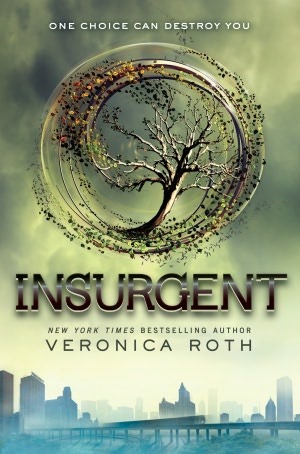
Book Review: Insurgent, by Veronica Roth

insurgent_coverInsurgent, the second YA dystopian book by Veronica Roth, is the awesome sequel that picks up on the action right where Divergent left off. Speaking of which, be sure to read predecessor first. This is a very fast-paced and exciting book sure to keep you on your toes.

This book takes place right after a massive civil war ravages the city of five society factions. In the aftermath, the protagonist, Tris, contemplates her guilt and sorrow from her actions. As fighting begins again, she will have to think quickly but profoundly about how much she is willing to sacrifice to protect her newfound friends, and the fate of the new society bound to come.

After reading this book, I think it is quite obvious that it evokes some very thoughtful and political questions in the reader. For example, the rebels, whom Tris is allied with, wants to completely wipe out the headquarters of the corrupt government. However, Tris and her prodigious soldier boyfriend both know that they have to save the computers there with advanced technology that the city sorely needs. So, how to accomplish both?

Another thing Veronica Roth does very well is connecting the protagonist and the reader. We can feel her anticipation, sorrow, and guilt in the upcoming war, her relationship issues, and her determination to do what’s in the new society’s interest.

Overall, Roth’s new thriller debut novel is something everyone should look into. You will definitely enjoy the relentless action and the profound thoughts weaved in and out of the story. And if you’re just getting into this series now, your timing is good– the end of the trilogy, Allegiant, comes out on October 22nd.

-Phillip X., 8th grade

Book Review: The Hunger Games, by Suzanne Collins

hunger_games_coverIn The Hunger Games by Suzanne Collins, you learn about friendship, courage, and much more.

This whole book is about a young girl named Katniss. Her country is divided into 12 districts, and then the capital. Each year, one girl and one boy are sent to the annual Hunger Games from each district. She has to go to her country’s annual Hunger Games. The Gunger Games is an event where 24 kids are put into an arena and are forced to fight to the death.

She makes many new friends along the way, but she also makes many new enemies. She has many tragedies along the way. For example, one of her closest friends in the games gets killed. Katniss helps unite the districts slowly throughout the story.

Her story consists of betrayal, love, hate, and friendship. Her journey has many ups and downs and it ends with an unforgettable event. I would recommend this book to anyone from the ages 12 and up. I believe that even adults will enjoy this book. Although you may not like the science fiction genre, I’m sure you will enjoy this book. This book will just make you want to pick up the next one!

-Melika R., 8th grade

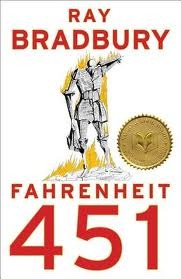
Book Review: Fahrenheit 451, by Ray Bradbury

fahrenheit451_coverIn Fahrenheit 451 by Ray Bradbury, the main character, Guy Montag, is a firefighter. However, he is not a firefighter in the traditional sense of the word.  Instead of putting out fires, his job is to set them.

In the future that this novel is set in, millions of books are banned and the only way people are allowed to learn is through television and radio programs, comics, and other forms of entertainment that make people “happy.” In this society, making people happy and equal to one another intellectually is the main goal. It is believed that higher forms of learning, such as the knowledge gained from most books, would be detrimental to this objective. In order to keep this objective, books are banned and burned when found in people’s possessions.  That is where Guy Montag’s job comes in. However, when he meets a curious girl named Clarisse, who, unlike the rest of society, likes asking questions, he begins to ask some questions of his own.

The tone of this novel is a dark one. It deals with the main character discovering a new, not necessarily good outlook on the world he accepted before. It also features many issues that could occur if society could not advance due to lack of knowledge. The idea of censorship that is addressed in this novel is a difficult one, and that is proven when the main character himself goes against his societal rules, his job, and his family values to experience what it is like to read books.

Ray Bradbury seems to want the reader to feel like a world without books would be unexceptional and monotonous. Without the knowledge and expertise that can be gained from reading, society could never advance and people would be stuck in the same rut that Guy Montag realizes he is in when he talks to Clarisse.  At one point in the book, Clarisse says to Guy “It’s a lot of funnels and a lot of water poured down the spout and out the bottom, and them telling us it’s wine when it’s not” (33).  This quote shows how their society is full of dreariness and lies in order for them to feel “happy” and “equal”. In reading this book, I have fully realized that I never want to experience a life without books. Overall, I think that Ray Bradbury was successful in making his readers feel a connection to Fahrenheit 451’s world that is lacking knowledge and advancement.

While this book was a bit tedious to read due to the author’s style of writing, which is so unlike current writing styles, I still am walking away from this novel with a new understanding of how important books are to society. Readers definitely need to read between the lines in order to fully understand both the underlying meaning and what is occurring. It reads more like rambling thoughts, which in a way tells the story better than any structured writing style would. Bradbury started and completed this novel in nine days on a rented typewriter that he payed for per half hour, which I personally find extremely impressive. While I was not the biggest fan of this book, I still feel like I have learned a lot from Fahrenheit 451 and I recommend it to both teens and adults alike.

-Kaelyn L., 10th grade

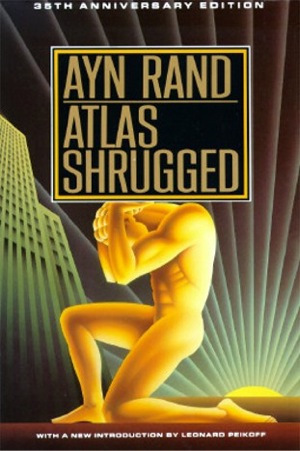
Book Review: Atlas Shrugged, by Ayn Rand

atlas_shrugged_coverIn this great nation of the United States, we have long maintained our democracy on a strict, two-party platform. In more recent times, these two positions have been filled by the left-leaning Democrats and right-leaning Republicans, but, aspiring to exercise to the fullest their rights as participants in the democratic process, smaller third parties have always managed to remain in existence. Among these more peripheral groups, one of the most prominent has long been the Libertarians who, in the opinion of this writer, offer a captivatingly stringent ideological adherence to the fundamental principles of liberty and small government.

Today’s brand of Libertarian represents a diverse membership, but many holding such a political ideology often cite in their political development one common influence. A Russian immigrant to the United States in the early 1900s, Ayn Rand, ceaselessly propagating her philosophy of objectivism, would later write one of the century’s most influential novels, an ideologically dense yet invigorating tale she named Atlas Shrugged, which appears to have become the gospel of the contemporary libertarian movement.

Set an ulterior, dystopian United States, in a world that is increasingly Marxist, the novel follows the events that surround Dagny Taggart, an executive of her family’s transcontinental railroad company. As her brother, James, the president of the corporation, increasingly engages in reckless and destructive business choices, seemingly sympathizing with the notion and proponents of a totalitarian state, Dagny becomes the real director of the company, attempting to extend its longevity to the greatest extent possible. Our protagonist finds solidarity with another rational man of business, Hank Rearden, president of Rearden Metal, whose innovative steel, the strongest and most durable of its kind, she utilizes for the construction of a new section of the Taggart rail network. Time progresses, and a trend of successful businessman leaving their corporations to fall into despair exponentially develops, yet Dagny and Hank fight on in their endeavor to merely remain above water.

While the world around them continues to grow grimmer and increasingly less hopeful, Dagny and Hank find one spark of hope in an abandon factory: a revolutionary engine that possesses the capacity to transform static electricity from the atmosphere into the energy needed to power a locomotive. Unaware of but desperate to discover the inventor of this engine, they embark on a quest that takes them to various places in a now hellish American country. Eventually, miraculously they find themselves in Galt’s Gulch, where they become acquainted with various figures, from business, medicine, art, and other important social spheres, including the aforementioned businessmen, all who have left their respective trades to join John Galt, with whom the reader, at this point in the story, is already somewhat familiar as the result of the novel’s widespread street phrase, “Who is John Galt?”

As the novel closes, the storyline wraps the mystery and uncertainty of why these people are present in Galt’s Gulch and what the future of the nation, and indeed the world, will be all together into a coherent, revelatory, and gripping ending, but that, as well as the answer to the question of Mr. Galt’s identity, is for you, reader, to discover for yourself.

In all verity, Atlas Shrugged is not an easy read. Its length alone might frighten some readers, but requiring even more mental faculty than that necessary to trudge through the nearly thousand pages is that required to pore the dense philosophical dogma that lies therein. Why, then, do I still maintain a positive opinion of and recommend this novel? The story is one that, though gripping, is even more so absorbing for its excellent use and conveyance of Rand’s beliefs. As it has affected countless others, Atlas Shrugged has similarly influenced my philosophical outlook and beliefs.

There will be those who will wholeheartedly disagree with Ms. Rand and her writings, yet the novel discussed here is worth the read even for the mental debate it will inevitably spark. If you are up for the challenge, as any good reader should be, and are open to intellectual growth, give Atlas Shrugged a shot.

-Sebastian R., 11th grade

Book List: Books for a Roadtrip

road_trip_tim_lucas

photo by flickr user Tim Lucas

Most of us have been stuck in a car or a plane for an extended period of time. Maybe your family is driving to another state. Or maybe you want a good book to read by the pool. Either way, the books you choose to bring with you matter. Earlier this summer, I drove to Palm Desert with my family, and chose the following books to read on during the vacation.wrinkle_in_time

A Wrinkle in Time by Madeleine L’Engle is a book I read when I was younger. I’d always liked the odd, sci-fi aspect of the story, but after rereading it, I fell in love all over again! As a diehard science fiction fan, A Wrinkle in Time is sci-fi gold. The main character is a girl named Meg whose father works for the government as a scientist. When he disappears, she and her siblings look into what their father was working on when he vanished. Meg finds that he was working on a project about something called a tesseraect (a geometric figure used for space and time travel that’s also been referenced in The Avengers). Meg, her youngest brother, and a misfit boy from Meg’s school travel through space and time to find Meg’s father.

childhoods_end_coverChildhood’s End by Arthur C. Clarke is targeted to have an older audience. It isn’t exactly young adult literature, but it is a phenomenal story about an alien invasion in the late 20th century. The humans begin calling these creatures, which remain in their spaceships, overlords. The book itself has an odd format; it has three parts, no main character, and is written in third person omniscient. It’s an excellent book to read because you get to discover the mysteries of the overlords along with the rest of the human race.

uglies_coverUglies by Scott Westerfeld is about a fifteen year old girl named Tally Youngblood. It is set three hundred years in the future, and on your sixteenth birthday, you get an operation so that you can be pretty. Tally only wants to become a pretty and live where all of the beautiful people are. However, her friend decides she doesn’t want the operation and escapes to the wild. Tally is given an ultimatum: help a secret branch of government locate her friend and the rest of the runaways and bring them back or stay ugly forever. Tally embarks on a journey that changes her views of the world, and ultimately, her future.

Each of these books are considered science fiction, and even if you don’t care for sci-fi, these books are incredibly well written.

-Madison M., 12th grade

Book Review: Beta, by Rachel Cohn

beta_coverBeta is a great book. You will never see the ending coming!

Elysia is a 16 year old Beta, or experimental clone, who lives on the island of Demesne, a paradise for the wealthiest people on Earth. When Elysia learns about the other clones on the island and becomes the replacement of a girl named Astrid, her life changes forever. Elysia starts to work for the governor’s family keeping the two children, ages 16 and 10, occupied.

Clones are beings without a soul who cannot feel, they work as servants for the members of Demesne, doing their chores, working as nannies and making Demesne a true paradise. Even the air and ocean surrounding has been altered for total relaxation.

But when defective Clones, called defects, begin to spread word of a revolution everything goes for a ride. Elysia meets other teens living on Demesne whom she befriends. She learns of the world of people, until her only chance at happiness is taken away with such cruelty she might not be able to handle it. Besides, if Elysia is meant to be a soulless being, why are all of these emotions arising? Could Elysia possibly be a defect? Elysia goes on an adventure of romance, action and adventure in the novel Beta.

I loved this book right up to the ending and I believe that many people will agree that Beta is a book you simply can’t put down.

-Danielle T., 7th grade

Book Review: Anthem, by Ayn Rand

anthem_cover

“You need to work with a partner or a group.”

“You have to know how to corroborate.”

“Group spirit is more important.”

“Don’t stand there by yourself, joy others!”

Do you hear these in your daily life, in school during classes, in field during sports, or even in the simplest activities? People say that the future society is for the one who knows how to work with others. However, in the novel Anthem by Ayn Rand, the author expresses her opinion by this future world with no ego.

In this world, the previous human history was abandoned that cities were covered with plants that grew incessantly. And in the society now, people don’t have the word “I,” “she,” or “he” in the dictionary.

“We are alone here under the earth. It is a fearful word, alone. The laws say that none among men may be alone, ever and at any time, for this is the great transgression and the root of all evil.”

Everyone works as a group and studies as a group, and everyone should be the same; when it comes to jobs, the law makers work as a group to decide the jobs randomly, which a genius may ends up being a street cleaner for the rest of his life. Ironically, people are named as a word with numbers, such as Equality 7-2521, but in fact, there is no such thing as real equality in this society.

There is no love. The government sets up reproduction process, sex, randomly. There is no marriage, no family, and laws control even the basic relationships.

However, an individual develops in this world. How will he survive and what can he change about this cold world?

I give this book a 9 out of 10. The topic is very unique that the author focuses on the idea of ego that people are forgetting in our society now. The only thing that I hope the author would add is the formation of this kind of society, which the story does not cover. How did the world change into this society that all men must be alike?

“Over the portals of the Palace of the World Council, there are words cut in the marble, which we repeat to ourselves whenever we are tempted:

‘We are one in all and all in one.

There are no men but only the great WE,

One, indivisible and forever.’”

-Wenqing Z., 11th grade

Book Review: The Program, by Suzanne Young

program_cover

“I’m going to die if I don’t cry right now. The sorrow is going to rip through my chest and kill me.” p. 43

The Program by Suzanne Young is unlike any book I have ever read before, set in a dystopian society with one key change to the world today. It takes place in a time when teen suicide is high, the government institutes The Program to “cure” depression. It also strips your memories and the essence of who you are.

“Would we commit suicide without The Program, or does it drive us there?” p. 63

Sloane has seen suicide firsthand, her brother’s. James, who is both her boyfriend and brother’s best friend, was also there. Now they live with survivors guilt. They both support each other and need each other to survive. Are their promises enough to withstand The Program?

It is never a matter if The Program will find you, but when they will. They will be free of The Program when they reach 18, but will they last that long? Can Sloane hold on to her love for James if her past is taken from her forever?

This is not a happy, light read kind of book. It deals with harsh topics plaguing society to this day. It is written in a way that feels so real, I have to remind myself it is only a story. I honestly had to put the book down a couple times just to cry; it was so sad.

Yet, I needed to know what happens next. The worst part is having likable characters that can’t fight back. At least, not at first. Even when it seemed hopeless, there was always some part of me that wished things would get better. You have to read the book to find out how it ends.

Due to the topic, this book is recommended for older teens. If you want a book that is deep and meaningful, (and will make you cry) this is the book for you.

-Nicole G., 10th grade